Picking your first longboard should be fun. Then you see the sizes. 28 inches. 36. 41. 44. Suddenly it feels like a maths test.
Here is the short answer. The best size longboard for beginners is 38 to 42 inches long and 9 to 10 inches wide. A board in that range is long enough to feel steady, and short enough to turn and carry without a fight.
Your height, your shoe size and the way you want to ride can nudge that number up or down a little. This guide walks you through all of it in plain English. By the end you will know your size, why it fits you, and which boards match it.
Quick answer
38 to 42 inches long, 9 to 10 inches wide
That is the best size longboard for most beginners. If you want one number, about 40 inches is the safest pick.
- 📏 Length: 38–42 in
- 📐 Width: 9–10 in
- 🛹 Wheels: 65–75 mm, soft
- ⬇️ Deck: lower is easier
What size longboard should a beginner get?
If you want one number, go for about 40 inches. That sits in the middle of the beginner sweet spot. Here is the full picture:
- Length: 38 to 42 inches. Long enough to be stable. Short enough to steer.
- Width: 9 to 10 inches. Wide enough that your feet actually fit on the deck.
- Wheels: 65 to 75 mm and soft. Look for a hardness rating around 78A to 83A. Big, soft wheels roll over cracks and small stones instead of stopping dead.
- Ride height: lower is easier. A drop-through board sits closer to the ground, so pushing and balancing take less effort.
Why this range? A longer board has its wheels farther apart. That gap is called the wheelbase. A longer wheelbase makes a board calmer and less twitchy, so you get more time to react. That matters a lot in your first few weeks, while your balance is still catching up.
Go too short and the board feels nervous under your feet. Go too long and it feels like steering a bus. The 38 to 42 inch range sits right between those two problems.
| You are… | Good starting length | Good width | Why it works |
|---|---|---|---|
| A smaller or lighter rider (under about 5′5″) | 36–41 in | 8.5–9.25 in | Easier to steer and carry, still steady |
| An average-height adult (5′5″ to 5′9″) | 38–42 in | 9–9.75 in | The classic beginner sweet spot |
| A taller rider (5′10″ and up) | 39–44 in | 9.5–10.25 in | Room for a wider, natural stance |
| A child or very small rider | Roughly 30–36 in | 8.5 in or a little less | Fits a narrower stance |
💡 Not sure? Pick the middle
A 40 or 41 inch board suits the widest range of beginners. If you are stuck between two sizes, the one closer to 40 is usually the safer choice.

Why longboard size matters when you are learning
Size is not about looking cool. It changes how the board behaves under you. When you are new, that behaviour decides whether a ride feels fun or scary.
Think of it like bikes. A small BMX bike turns on a coin but feels jumpy. A big cruiser bike feels relaxed and steady. Longboards work the same way. Four things change with size:
- Stability. Longer boards react more slowly to small movements. A wobble in your ankles does not turn into a sudden swerve.
- Foot room. A bigger deck lets you stand with your feet about shoulder-width apart. That is your most balanced stance. On a tiny deck you have to squeeze in.
- Turning. Shorter boards turn tighter and quicker. Longer boards draw wide, smooth curves. Quick turning is handy on busy pavements, but it is also easier to overdo.
- Carrying. Every extra inch adds weight and bulk. You will notice it on stairs, on the bus and under a desk.
Here is how the three main size groups compare side by side:
| Feature | Shorter (under 36 in) | Mid-size (38–42 in) | Longer (44 in and up) |
|---|---|---|---|
| Stability at beginner speeds | Lower | High | Highest |
| Turning | Quick and tight | Smooth and predictable | Wide and slow |
| Carrying and storage | Easiest | Manageable | Bulky |
| Foot room | Tight | Comfortable | Lots |
| Good first board? | ⚠️ Only for small riders or if you must carry it a lot | ✅ Yes, for most people | ✅ Yes, if you are tall or want relaxed cruising |
The right size does not make you a better rider. It makes learning easier. Choose the size that forgives your mistakes.
So what does this mean for you? As a beginner, you want a board that stays calm while you learn to push, turn and stop. That is exactly what a mid-size board does. You can always add a smaller, livelier board later, once your balance is solid.
Longboard sizes explained: length, width and wheelbase
Product pages throw a lot of numbers at you. Only four really matter for sizing. Here is what each one means and how to use it.
Length: the number everyone quotes
Length is measured from the tip of the nose to the end of the tail. Most longboards run from about 32 to 46 inches. Some go shorter (mini cruisers) and some go much longer (dancing boards).
Mini cruiser 30 in
Cruiser 36 in
⭐ Mid-size (beginner sweet spot) 40 in
Full-size cruiser or pintail 44 in
Board lengths drawn to scale. The yellow marks show roughly where the wheels sit.
Length is a handy shortcut, but it does not tell the whole story. Two 40-inch boards can ride very differently, depending on their shape and where the wheels sit. Treat length as your first filter, not your final answer.
| Size group | Typical length | How it feels | Beginner friendly? |
|---|---|---|---|
| Mini cruiser | 28–32 in | Nimble and easy to carry, but twitchy | ⚠️ Harder to learn on |
| Cruiser | 32–38 in | Agile and still fairly steady | ✅ Good for smaller riders |
| Mid-size longboard | 38–42 in | Stable, smooth and easy to push | ✅ The sweet spot |
| Full-size cruiser or pintail | 42–46 in | Very stable, with wide, surfy turns | ✅ Great for tall riders |
| Dancer | 46 in and up | A huge platform for footwork | ⚠️ Better as a second board |
These groups are informal. Brands use the names loosely, so always check the actual measurements.
Width: where your feet live
Width is measured across the widest part of the deck. Most longboards are between 8.5 and 10.5 inches wide.
Width matters for two reasons. The first is comfort: your feet need somewhere to stand. The second is control. You steer a longboard by leaning on your toes or your heels. A deck that matches your feet gives you good leverage. A deck that is far too wide for small feet takes more effort to tip into a turn. One that is far too narrow leaves your toes and heels hanging in the air.
Wheelbase: the hidden number
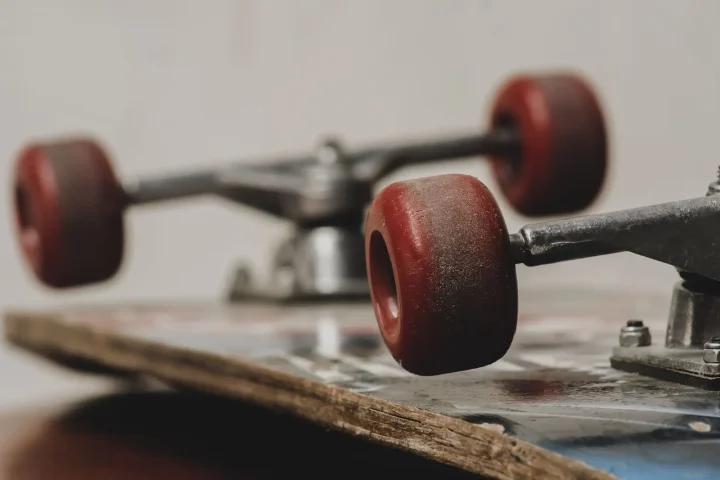
Wheelbase is the distance between the front and back trucks. (Trucks are the metal T-shaped parts that hold the wheels.) On most full-size longboards it is somewhere between two and three feet.
This is the number that really controls stability. A longer wheelbase means a calmer ride and wider turns. A shorter one means a livelier ride and tighter turns.
Here is the catch. Two boards of the same length can have very different wheelbases. A drop-through board usually has its trucks close to the ends, so its wheelbase is long for its size. A board with a kicktail (an upturned tail) has its back truck further in, so its wheelbase is shorter.
📌 Use the wheelbase if you can find it
If a product page lists the wheelbase, compare it. For a first board, the longer wheelbase is the more forgiving choice.
Ride height: how far you stand from the ground
Ride height is not printed on most product pages, but you can spot it from the board type:
- Top-mount. The deck sits on top of the trucks. You stand higher. Turning feels lively, but each push means bending your standing leg a little more.
- Drop-through. The trucks poke through holes in the deck, so the deck hangs lower. Pushing is easier and the board feels steadier.
- Drop deck (also called drop-down). The standing area is shaped to dip below the trucks. This is the lowest style and usually the easiest to push.
A lower board makes its length feel friendlier. That is why a 41-inch drop-through is such a common first board. It is long and low, which is a forgiving mix.
Best size longboard for beginners by height
Height matters because it sets your natural stance. Taller riders stand with their feet wider apart, so they need more deck between the trucks. Shorter riders need less.
Use this chart as your starting point. It shows a good length and width for an all-round first board.
| Your height | Starting length | Deck width |
|---|---|---|
| Under 5′0″ (under 152 cm) | 36–40 in | 8.5–9 in |
| 5′0″ to 5′4″ (152–163 cm) | 37–41 in | 8.75–9.25 in |
| 5′5″ to 5′9″ (165–175 cm) | 38–42 in | 9–9.75 in |
| 5′10″ to 6′1″ (178–185 cm) | 39–43 in | 9.5–10 in |
| Over 6′1″ (over 185 cm) | 40–44 in | 9.75–10.25 in |
These are the same starting ranges used by our free Longboard Size Guide tool, which also factors in your weight, riding style and terrain.
A chart is a starting point, not a law. The ranges overlap on purpose. A 40-inch board appears in every row, which is exactly why it is such a popular first size. If you are between two rows, think about how you will use the board. Carrying it a lot? Go toward the shorter end. Want the steadiest ride you can get? Go toward the longer end.
A quick stance check you can do at home
Stand naturally with your feet a little wider than your shoulders and your knees soft, as if you were about to catch a ball. Ask someone to measure from the outside of one foot to the outside of the other. The standing area between the trucks on your board should give you at least that much room, with a little to spare.
Buying for a child? Kids and very small riders often do better on a shorter board, roughly 30 to 36 inches, because their stance is narrower. An adult-size 44-inch board can be hard for a small child to steer.
Want a size worked out just for you? Our free tool takes about a minute.
Do weight and shoe size change the best size?
Yes, but not in the way most people expect. Weight mostly changes how stiff your board should be. Shoe size changes how wide it should be. Neither changes the best length very much.
Weight: think stiffness and weight limit, not length
Many longboard decks bend a little under you. That bend is called flex. A bit of flex soaks up bumps and feels comfortable. Too much flex for your weight makes the board feel mushy, and in the worst case the deck can sag toward the ground.
- Lighter riders (under about 120 lb) can enjoy a deck with medium flex. A very stiff board may feel like a plank.
- Mid-weight riders suit most standard decks with medium flex.
- Heavier riders (around 200 lb and up) usually feel more stable on a stiffer deck. Check the weight limit before anything else.
Many popular complete boards list a rider weight limit. On Amazon it is often shown as “load capacity”. All three boards in our picks below list 220 lb, for example.
⚠️ Always check the weight limit
If you are close to or over the listed limit, choose a board rated for more. Do not guess. An overloaded deck can flex too far or break.
Shoe size: match the width to your feet
Your toes and heels should sit near the edges of the deck. A little overhang is normal and fine. A lot of overhang means the deck is too narrow for you.
| US men’s shoe size | US women’s (approx.) | Deck width to look for |
|---|---|---|
| 7 and under | 8.5 and under | 8.5–9 in |
| 7.5 to 9.5 | 9 to 11 | 9–9.5 in |
| 10 to 11.5 | 11.5 and up | 9.5–10 in |
| 12 and up | — | 10 in or wider |
Shoe sizes vary between brands, so treat this as a rough guide. If you are between two widths, beginners are usually happier on the wider one. It simply gives you more to stand on.
Best size by riding style
How you plan to ride also shapes the best size. The good news is that the three beginner-friendly styles all overlap in the same 38 to 42 inch zone.
| How you want to ride | Typical length | Shape to look for | OK for a first board? |
|---|---|---|---|
| Cruising (relaxed rides) | 32–42 in | Pintail, cruiser or drop-through | ✅ Yes |
| Carving (flowing S-turns) | 38–44 in | Pintail or directional top-mount | ✅ Yes |
| Commuting (getting places) | 38–42 in | Drop-through or drop deck | ✅ Yes |
| Dancing and freestyle | 42–50 in | Long, flexible top-mount | ⚠️ Possible, but a lot of board |
| Freeride (sliding) | 38–42 in | Symmetrical drop-through or top-mount | ❌ Learn the basics first |
| Downhill (speed) | 36–40 in | Stiff, low deck | ❌ Advanced riders only |

Cruising means relaxed rides on paths and quiet streets. Almost any stable board works, so use your height to choose the length.
Carving means linking smooth S-shaped turns, a bit like surfing on tarmac. A slightly longer board, often a pintail, gives those turns a lovely flow.
Commuting means getting from A to B. You will push a lot, so a low drop-through board saves your legs. Keep it under about 42 inches if you need to carry it indoors.
Dancing means walking and stepping on the board as it rolls. It needs a very long deck, which is a lot to manage on day one. Most people are better off learning the basics on a mid-size board first.
Freeride and downhill involve sliding and high speed. They are not beginner styles, whatever size the board is.
🛡️ Speed comes later
Learn to push, turn and foot brake on flat ground before you go near a hill. Wear a helmet on every ride. Wrist guards, knee pads and elbow pads are well worth it while you are learning.
Not sure what your style is yet? That is completely normal. Take our free Longboard Match Quiz for a quick pointer.
Our picks: 3 beginner longboards in the right sizes
Now you know your size, here are three well-known complete boards that fit it. There is one for each part of the beginner range: shorter, middle and longer.
🔎 How we chose these
We picked these boards by size, shape and the specifications listed on Amazon. We have not ride-tested them, and we do not show prices or star ratings because they change often. Specs were checked in October 2026, so confirm the details on the product page before you buy. LongboardHub earns from qualifying purchases as an Amazon Associate, at no extra cost to you. Read our affiliate disclosure.
🏆 Best all-round beginner size
Shape illustration, not a product photo
Atom Drop Through Longboard (41 in)
Best for: Most adult beginners who want an easy, steady first board for cruising and getting around.
At 41 inches, this board sits right in the beginner sweet spot. It is a drop-through, which means the deck hangs low between the wheels. A low deck is easier to push and feels steadier under your feet. The Amazon listing marks its skill level as beginner.
- Length 41 in
- Width 9 in
- Deck Maple laminate, drop-through
- Trucks Reverse kingpin, 245 mm axles
- Wheels 70 mm, soft
- Listed weight limit 220 lb
✅ Why it works for beginners
- The low drop-through deck takes effort out of every push.
- A 41-inch length gives a long, calm wheelbase.
- The deck is cut away around the wheels, which the maker says removes wheel bite (the wheel rubbing the deck in a hard turn).
- It is listed as arriving fully assembled.
⚠️ Keep in mind
- The 9-inch deck is on the narrow side for big feet (about US men’s 12 and up).
- The listed weight limit is 220 lb.
- At 41 inches it is not the easiest board to carry on a crowded bus.
Buy from Amazon Price and stock are shown on Amazon. Specs are from the Amazon listing, checked October 2026.
🌿 Best shorter size
Shape illustration, not a product photo
Atom Pin-Tail Longboard (39 in)
Best for: Smaller and lighter riders, teens, and anyone who wants a classic cruiser that is a bit easier to carry.
A 39-inch pintail is a friendly size if a 41 or a 44 feels like too much board. The teardrop shape narrows toward the tail, which keeps the deck clear of the wheels in turns. The Amazon listing describes it as ideal for beginner riders.
- Length 39 in
- Width 9 to 9.4 in (the listing shows both)
- Deck Maple laminate pintail
- Trucks 8.5 in aluminum
- Wheels 65 mm, 78A
- Listed weight limit 220 lb
✅ Why it works for beginners
- It is two inches shorter than the 41, so it is easier to steer and carry.
- Soft 78A wheels grip well and soak up small bumps.
- The classic pintail shape helps you avoid wheel bite, according to the listing.
- It is listed as arriving fully assembled.
⚠️ Keep in mind
- It is a top-mount board, so you stand higher than on a drop-through. Pushing takes a little more effort.
- The 65 mm wheels are on the small side for very rough roads.
- The listed weight limit is 220 lb.
Buy from Amazon Price and stock are shown on Amazon. Specs are from the Amazon listing, checked October 2026.
🏄 Best longer size
Shape illustration, not a product photo
Retrospec Zed Pintail Longboard (44 in)
Best for: Taller riders, riders with big feet, and anyone who wants a roomy deck for relaxed, surfy cruising.
At 44 inches long and 10 inches wide, the Zed gives you plenty of room to find your stance. That extra length makes for a calm ride and wide, flowing turns. The Amazon listing marks its skill level as beginner.
- Length 44 in
- Width 10 in
- Deck 8-ply Canadian maple with bamboo
- Trucks Reverse kingpin
- Wheels 70 mm, 85A
- Bearings ABEC-7
- Listed weight limit 220 lb
✅ Why it works for beginners
- The 10-inch-wide deck gives bigger feet room to stand.
- The long deck suits a wide stance, which helps taller riders feel balanced.
- Wheel wells are cut into the deck to help prevent wheel bite, according to the listing.
- It is listed as arriving fully assembled.
⚠️ Keep in mind
- Forty-four inches is bulky to carry and store.
- The 85A wheels are a little firmer than the softest cruising wheels, so rough roads will feel bumpier.
- The listed weight limit is 220 lb.
- It is sold in several deck designs. Our link opens one of them.
Buy from Amazon Price and stock are shown on Amazon. Specs are from the Amazon listing, checked October 2026.
| Board | Length | Width | Wheels | Best for | Amazon |
|---|---|---|---|---|---|
| Atom Pin-Tail | 39 in | 9 to 9.4 in | 65 mm, 78A | Smaller riders, easy carrying | View on Amazon |
| Atom Drop Through | 41 in | 9 in | 70 mm, soft | Most adult beginners | View on Amazon |
| Retrospec Zed | 44 in | 10 in | 70 mm, 85A | Tall riders, big feet | View on Amazon |
Which one should you choose? Match it to the height chart:
- Under about 5′5″, or you need something easier to carry: the 39-inch Atom Pin-Tail.
- Average height, and you want the easiest ride: the 41-inch Atom Drop Through.
- Tall, with big feet, or you want relaxed cruising: the 44-inch Retrospec Zed.
All three list a 220 lb weight limit. If you weigh more than that, keep the sizes from this guide and look for a board with a higher listed limit.

How to choose your longboard size in 5 steps
Here is the whole process in order. It takes about five minutes.
- Measure yourselfNote your height and your shoe size. These two numbers do most of the work.
- Decide how you will ride mostCruising, carving or commuting? If you are unsure, plan for cruising. It is where most beginners start.
- Pick your lengthFind your height in the chart above. If you will carry the board a lot, lean shorter. If you want the steadiest ride, lean longer.
- Match the width to your shoesUse the shoe-size table. When in doubt, go slightly wider.
- Check the beginner-friendly detailsLook for a low deck if you will push a lot, soft wheels of about 65 to 75 mm, a weight limit above your weight, and a complete board that is ready to ride.
Why does this order work? It starts with the things you cannot change (your body) and ends with the things you can (the board). That stops you falling for a great graphic on a board that does not fit.
One more thing. If you can, stand on a board before you buy. A friend’s board or a local skate shop will tell you more in ten seconds than any chart. If you cannot, the chart and the steps above will get you very close.
Real-life examples: which size would they choose?
Sizing advice makes more sense with real situations. The riders below are made-up examples, based on the kind of questions beginners often post in longboarding groups and forums. They are not real people or reviews. See which one sounds most like you.
The campus cruiser
Maya, 5′3″
Maya wants to roll between classes. She has to carry her board into lecture halls and tuck it under a seat.
Good size: about 38 to 39 in long and around 9 in wide. Light enough to carry, long enough to stay steady.
The short commuter
Jordan, 5′9″
Jordan rides two miles to work. The pavements are cracked and rough in places.
Good size: a 40 to 41 in drop-through with soft wheels of 70 mm or more. The low deck saves effort on every push, and big soft wheels smooth out the cracks.
The tall rider with big feet
Sam, 6′3″, 215 lb
Sam wears size 13 shoes and wants to cruise the beach path at weekends.
Good size: 42 to 44 in long and about 10 in wide, with a weight limit comfortably above 215 lb. A 9-inch deck would leave his feet hanging off, and a 220 lb limit is too close for comfort.
The parent
Priya, buying for a 9-year-old
Priya is choosing a first board for her daughter and is tempted by a big board she can “grow into”.
Good size: a shorter board of about 30 to 34 in with soft wheels, plus a helmet and pads. A child’s narrow stance cannot steer an adult-size deck easily.
The future dancer
Alex, 5′7″
Alex has watched longboard dancing videos and wants a 46-inch dancer straight away.
Good size: a 40 to 42 in all-rounder first. Pushing, turning and stopping come before footwork. The dancer makes a great second board.
Notice the pattern. Nobody picked a size because it looked good. Each rider started with their body and their plans, then let those choose the board.
Common beginner sizing mistakes (and how to fix them)
Most sizing regrets come from the same handful of mistakes. Here they are, with the fix for each.
❌ Buying a mini cruiser because it is easy to carry
Short boards are twitchy and have little foot room. They are fun later, but they make the first weeks harder than they need to be.
✅ The fix: Start at 38 to 42 inches, unless you are a small rider or you truly have to carry the board everywhere.
❌ Choosing by graphic first
A great design on the wrong size is still the wrong board.
✅ The fix: Filter by size and shape first. Then pick your favourite design from what is left.
❌ Ignoring the width
Lots of people check the length and forget the width. Then their toes and heels hang off the edges.
✅ The fix: Use the shoe-size table above. If in doubt, go a little wider.
❌ Skipping the weight limit
An overloaded deck flexes too much and wears out sooner. It can also be unsafe.
✅ The fix: Find “load capacity” or “weight limit” on the product page before you add anything to your basket.
❌ Thinking longer is always safer
Extra length helps up to a point. Past about 44 inches, boards get heavy and slow to turn.
✅ The fix: Stay inside the range for your height.
❌ Blaming the size for a setup problem
A board that will not turn, or that feels wobbly, may simply need its trucks adjusted.
✅ The fix: Turn the large nut on each truck a quarter turn at a time. Looser makes turning easier. Tighter makes the board feel steadier.
❌ Buying for the rider you hope to become
Downhill and dancing boards are built for skills you do not have yet.
✅ The fix: Buy for your first six months. A specialist board makes a great second board.
Pro tips to get the size right first time
These small checks cost nothing and save a lot of second-guessing.
- Do the tape testMark the board’s length on the floor with masking tape. Stand on it in your riding stance. You will know straight away if it feels cramped or huge.
- Compare wheelbase, not just lengthIf two boards are the same length, the one with the longer wheelbase will feel calmer.
- Buy a complete boardA complete arrives assembled, with parts chosen to work together. That removes a lot of guesswork from a first purchase.
- Check the return policyIf the size feels wrong out of the box, you want an easy way to send it back.
- Give it two weeksAny new board feels strange at first. Ride on flat, smooth ground for a couple of weeks before you decide the size is wrong.
- Tune before you replaceSofter wheels or a small truck adjustment can make a board feel like a different size.
A longboard that fits you disappears under your feet. You stop thinking about the board and start enjoying the ride.
Frequently asked questions
What size longboard is best for a beginner?
For most adult beginners, the best size is 38 to 42 inches long and 9 to 10 inches wide. A board of about 40 inches is the safest single choice, because it is stable but still easy to turn and carry.
Is a 40-inch longboard good for beginners?
Yes. Forty inches sits in the middle of the beginner range and suits most adult heights. Pair it with soft wheels of about 65 to 75 mm. If you will push a lot, choose a low drop-through deck.
Is a shorter or longer longboard easier to learn on?
Longer is usually easier, up to a point. More length means a longer wheelbase, which feels steadier. Past about 44 inches a board gets heavy and slow to turn, so most beginners do best between 38 and 42 inches.
What size longboard should I get for my height?
As a starting point: under 5 feet tall, about 36 to 40 inches. From 5 ft to 5 ft 4 in, 37 to 41 inches. From 5 ft 5 in to 5 ft 9 in, 38 to 42 inches. From 5 ft 10 in to 6 ft 1 in, 39 to 43 inches. Over 6 ft 1 in, 40 to 44 inches.
Does my weight affect what size longboard I need?
Weight affects stiffness more than length. Heavier riders usually want a stiffer deck and should always check the listed weight limit. Lighter riders can enjoy a deck with more flex.
What size longboard is best for kids?
Children usually do better on a shorter board of roughly 30 to 36 inches, because their stance is narrower. Add soft wheels, a helmet and pads, and supervise young riders.
Your beginner longboard size checklist
Save this list or take a screenshot. If a board ticks every box, it is a good size for you.
- The length matches my height range (38 to 42 in for most adults).
- The width matches my shoe size (9 to 10 in for most adults).
- The wheelbase is on the longer side, for a calm ride.
- The deck is low (drop-through or drop deck) if I will push a lot.
- The wheels are soft and about 65 to 75 mm.
- The listed weight limit is comfortably above my weight.
- It is a complete board, ready to ride.
- I can carry it and store it where I need to.
- I have a helmet, and pads while I learn.
That is it. The best size longboard for beginners is the one that keeps you steady while you learn. For most people, that is about 40 inches long and 9 to 10 inches wide. Pick your size, grab a helmet and enjoy those first rides.
Still deciding?
Get a size worked out for you, or jump back to the three boards that fit the beginner range.
Try the free Size Guide Take the Match Quiz Back to our picks
Board specs and availability were checked in October 2026 and can change. Always confirm the details on the product page before you buy.