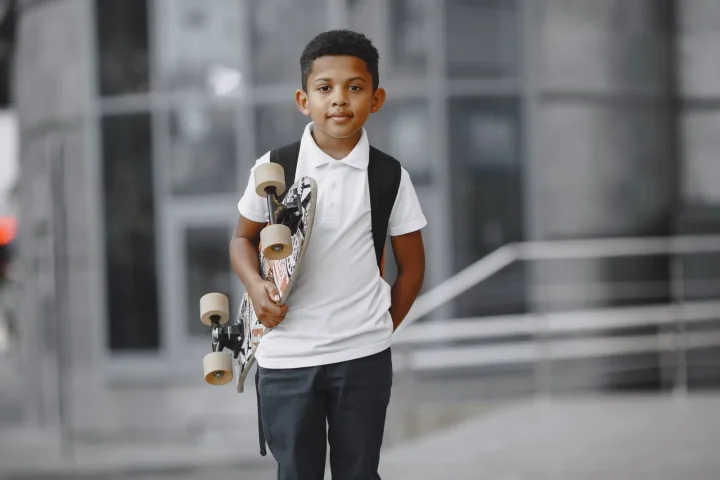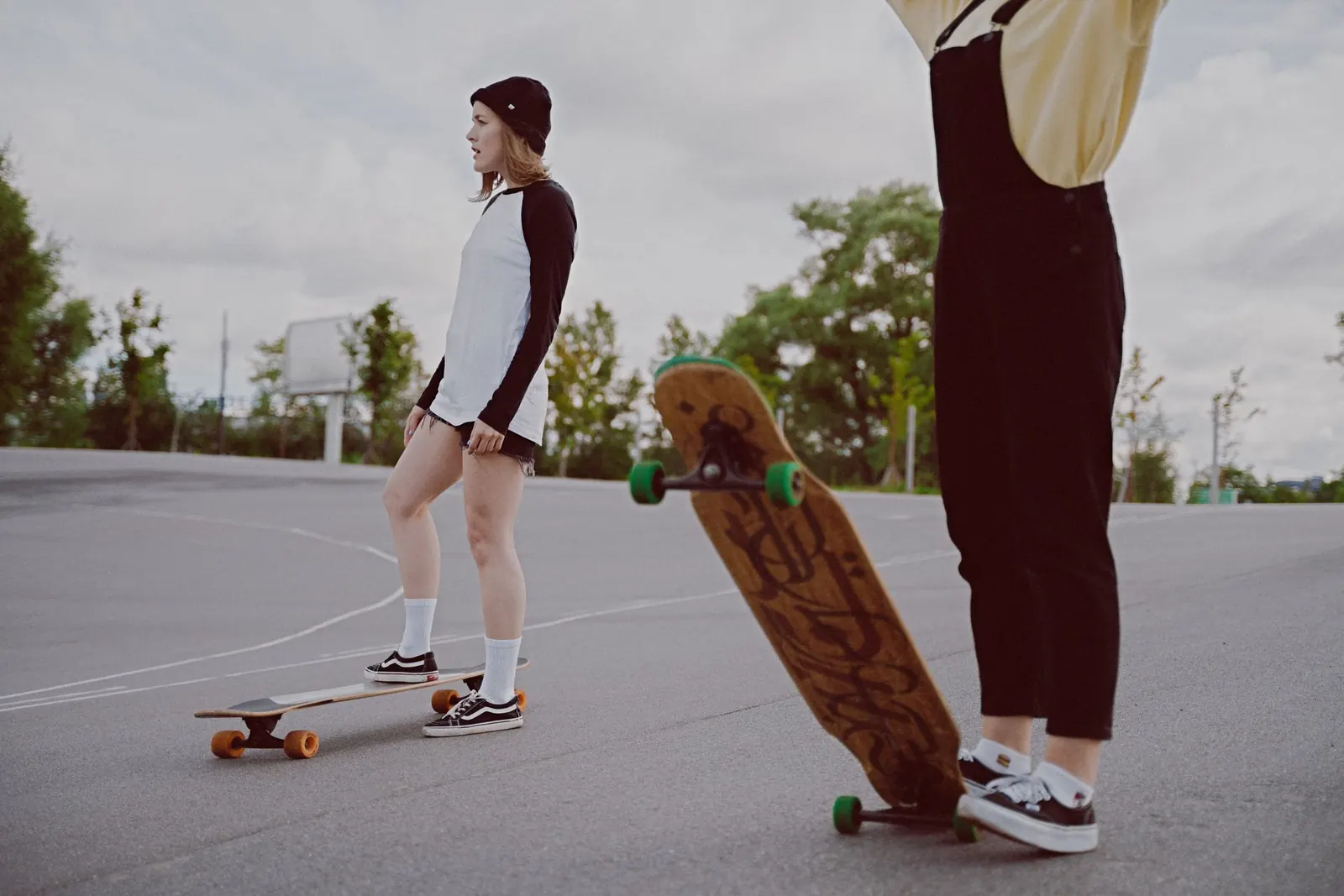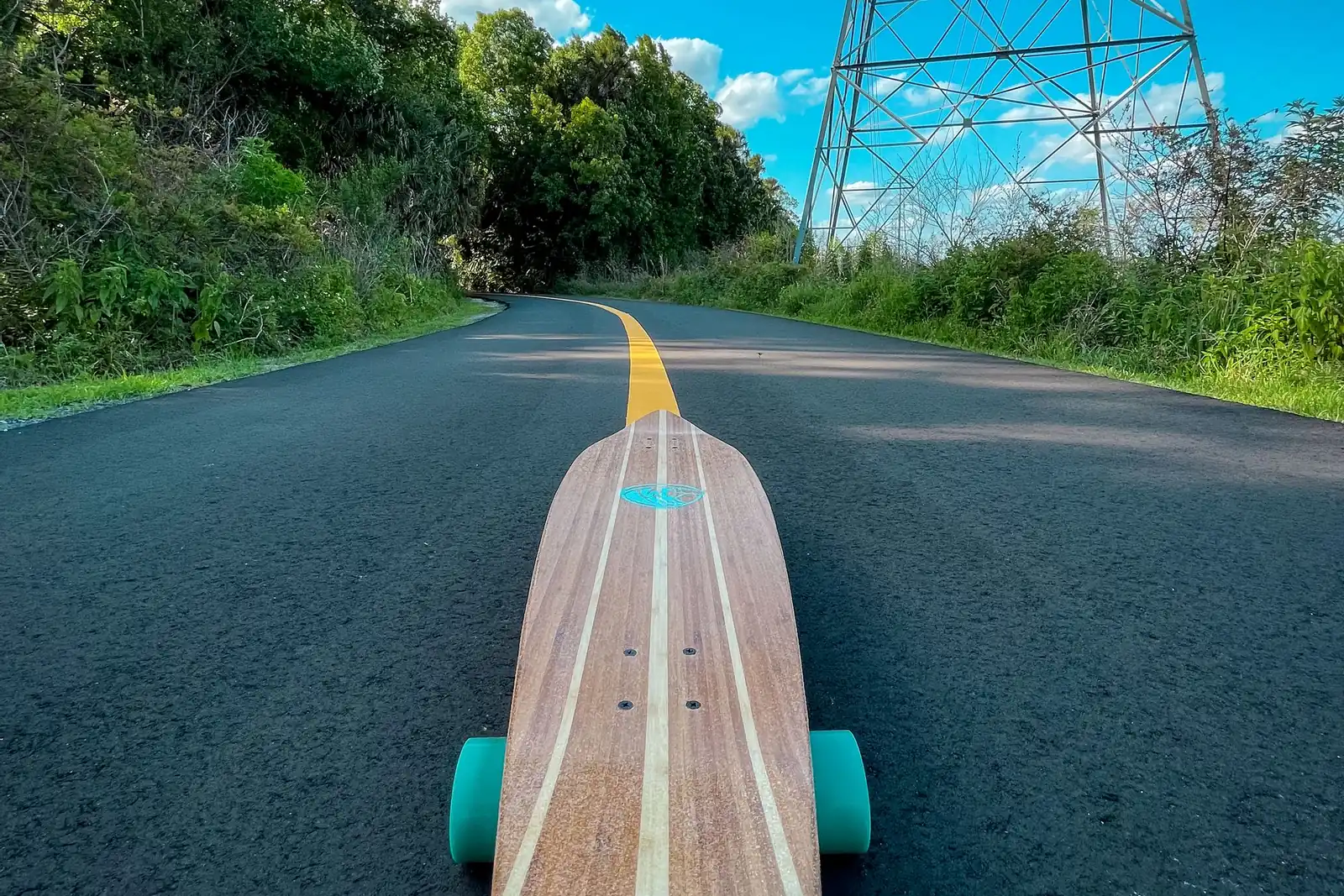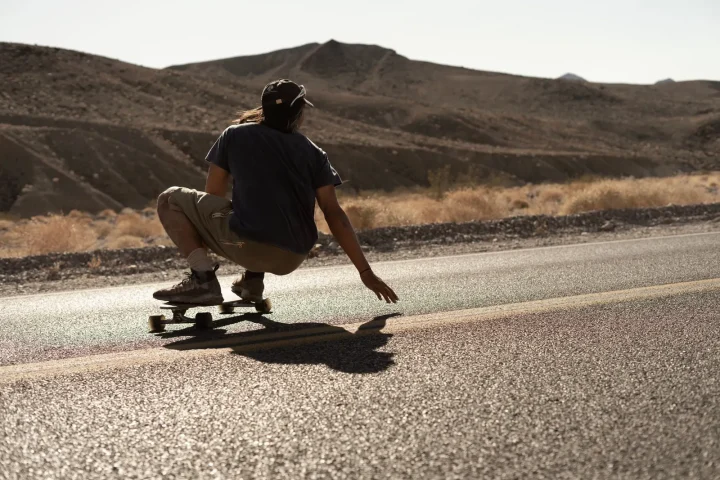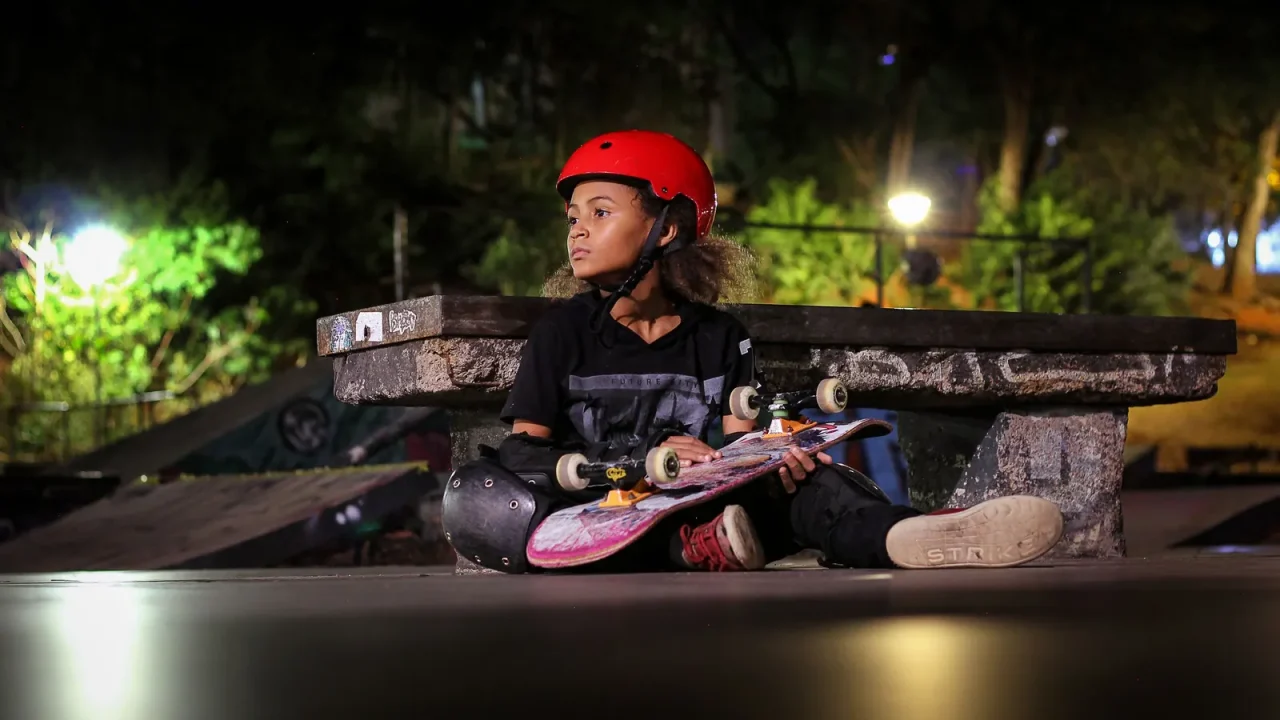
Your child wants a longboard. Maybe a friend has one. Maybe they saw a video. Now you are looking at dozens of boards with no idea which is suitable, or whether the whole thing is a good idea.
Here is the short answer. A good beginner longboard for a child or teen fits their height, rolls on soft wheels and comes with a helmet. Younger children suit small cruisers of about 27 to 32 inches. Teenagers of five feet and taller can ride the same 37 to 41 inch boards that adult beginners use.
This guide is for parents and carers. It goes through what suits each age group, how to keep the risks sensible, how to teach the first skills over four weeks, and which boards are worth a look.
Quick answer
Fit the height, insist on soft wheels, start with a helmet
Under five feet tall, choose a small cruiser. Over five feet, an adult beginner board is the right size.
- 👶 Kids: 27–32 in
- 🧑 Teens: 37–41 in
- 🛞 Soft 78A wheels
- ⛑️ Helmet from day one
Is longboarding suitable for kids and teens?
It is a fair question to start with. Longboarding is a physical activity on a moving board, so falls are part of learning. The honest answer has two halves.
The first half: there is real risk. Children fall, and falls on hard ground can cause grazes, sprains and occasionally broken wrists or worse. Riding near traffic or down hills raises the stakes a great deal.
The second half: most of that risk can be managed. A helmet and pads, a flat traffic-free place to ride, a board that fits and an adult nearby make the early sessions far safer. Above all, teach them to stop before they learn to go fast.
| Raises the risk | Lowers the risk |
|---|---|
| No helmet or pads | A helmet, wrist guards and knee pads every time |
| Riding near cars | A traffic-free park, path or playground |
| Hills before they can stop | Flat ground until foot braking is reliable |
| A board that is too big | A board matched to their height |
| Hard plastic wheels | Soft polyurethane wheels |
| Riding alone when young | An adult close by |
There are real benefits on the other side of the scale. A longboard gets a child outdoors and moving. It builds balance, coordination and persistence, because nobody gets it right the first time. And for teenagers, it is a way of getting to school or to friends under their own steam.
🛡️ Set the helmet rule before the board arrives
Agree it in advance: no helmet, no riding, with no exceptions. It is far easier to start with the rule than to add it later. See our safety guides.
An age-by-age guide
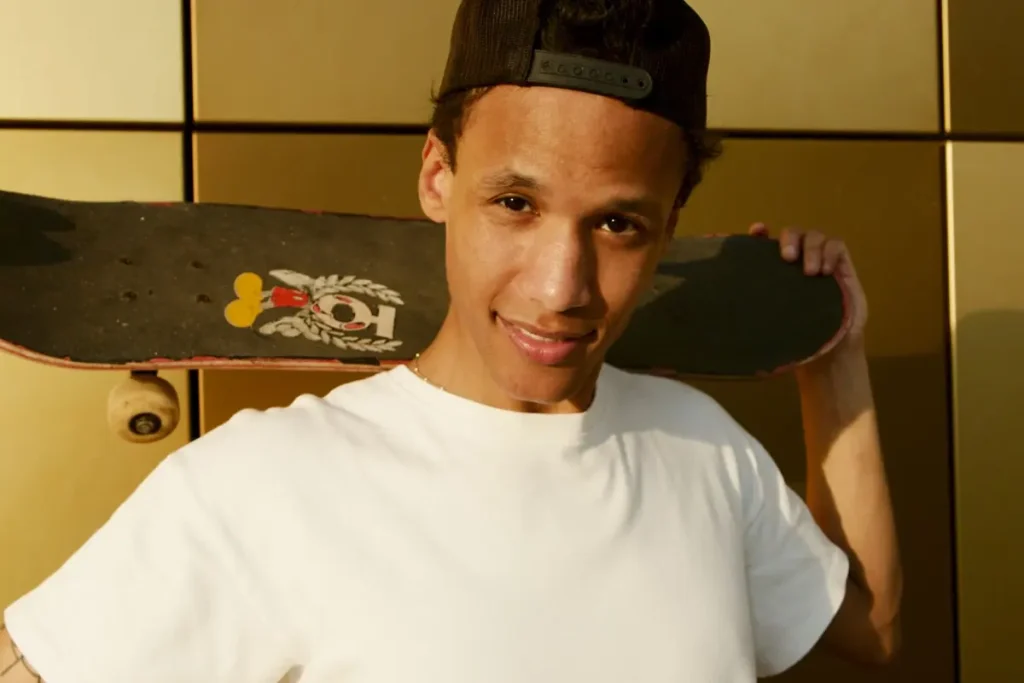
Height matters more than age for choosing a board. Age matters more for what a child can safely do. This table brings the two together. Treat the ranges as starting points.
| Age group | Typical height | Board to look for | Where to ride |
|---|---|---|---|
| 5 to 7 | Under 4′0″ | Mini cruiser, 22–28 in | Flat, enclosed spaces with an adult alongside |
| 8 to 10 | 4′0″ to 4′6″ | Mini or small cruiser, 27–32 in | Parks and playgrounds, adult nearby |
| 11 to 13 | 4′6″ to 5′2″ | Cruiser, 30–38 in | Quiet paths and parks |
| 14 to 17 | 5′0″ and up | Beginner longboard, 37–41 in | Paths and quiet streets, where local rules allow |
Ages 5 to 7
At this age, riding is play. Expect short bursts of interest and plenty of sitting on the board. A small, light cruiser is all they need. Stay within arm’s reach, keep to completely flat ground, and do not worry about technique.
Ages 8 to 10
Children of this age can learn to push, turn and stop properly. They are strong enough to carry a small board and coordinated enough to enjoy it. A board of 27 to 32 inches with soft wheels suits most of them. This is a great age to build good habits, because they still listen.
Ages 11 to 13
Growth spurts make sizing tricky here. Measure before you buy, and do not rely on last year’s height. Many children in this group suit a 30 to 36 inch cruiser. Taller ones can move straight to a small longboard. Independence starts to matter, so agree clear rules about where they can ride.
Ages 14 to 17
Most teenagers are tall enough for adult sizing, and an adult beginner board is the right purchase. A drop-through of about 38 to 40 inches is the most forgiving choice. The challenge at this age is not the board. It is speed, hills, traffic and friends. More on that below.
For anyone over about five feet, our free tool gives a size for their height and weight.
What to look for, and what to avoid
| Look for | Avoid |
|---|---|
| Polyurethane wheels with a stated hardness of about 78A | Hard plastic wheels |
| Metal trucks that can be adjusted | Plastic trucks |
| A wooden deck with grip tape | A very narrow or slippery deck |
| A length matched to the child’s height | A board bought to grow into |
| A weight the child can carry | A heavy adult board for a small child |
| A clear, consistent product listing | Listings with no specifications |
Soft wheels are the single most important thing. They roll over cracks and small stones. Hard plastic wheels stop dead on anything rough, and the rider keeps going. If you only check one thing, check the wheels.
Size is the second. A board that is too long cannot be steered by a small child, however determined they are. It is the most common reason a new board ends up unused.
The gear to buy with the board
Order the safety gear at the same time as the board, so nobody is tempted to have a quick go without it.
- A helmet. Choose one certified for skateboarding or cycling, in the right size. It should sit level, low on the forehead, and should not wobble. In the United States, look for CPSC or ASTM F1492 on the label.
- Wrist guards. Children instinctively put their hands out when they fall. Wrist guards with a rigid splint take that impact.
- Knee pads. A hard cap over foam padding. Knees hit the ground first in a forward fall.
- Elbow pads. Useful for sideways falls.
- Closed shoes with flat soles. No sandals, no bare feet.
Teenagers will sometimes resist pads. A helmet remains non-negotiable. Slim, low-profile pads are easier to accept than bulky ones, and they are much better than no pads at all.

Our picks: 3 boards by age, plus a pad set
These cover three stages: a small cruiser for younger children, a manageable longboard for pre-teens and smaller teens, and a full-size beginner board for taller teenagers.
🔎 How we chose these
We picked these products by the specifications listed on Amazon and by how well they fit the job. We have not ride-tested them, and we do not show prices or star ratings because they change often. Specs were checked in October 2026, so confirm the details on the product page before you buy. LongboardHub earns from qualifying purchases as an Amazon Associate, at no extra cost to you. Read our affiliate disclosure.
👶 Best for about 7 to 11
Magneto Mini Cruiser (27.5 in)
Best for: Younger children who need a small, light board.
A small wooden cruiser with a kicktail at each end. The listing describes it as easy to carry and suitable for kids, teens and adults.
- Length 27.5 in
- Width 7.5 in
- Deck 8-ply Canadian maple, double kicktails
- Trucks Aluminum
- Wheels 60 mm, 78A
- Listed weight limit 275 lb
✅ Why it works
- At 27.5 inches it fits in a locker or under a desk.
- Soft 78A wheels roll far more smoothly than hard trick wheels.
- Double kicktails make kerbs and tight turns manageable.
- The listing marks its skill level as beginner.
⚠️ Keep in mind
- A short board is twitchier than a full-size longboard.
- The 7.5-inch deck is narrow for adult feet.
- Small 60 mm wheels feel rough roads more.
Buy from Amazon Price and stock are shown on Amazon. Specs are from the Amazon listing, checked October 2026.
🧒 Best for pre-teens and smaller teens
Shape illustration, not a product photo
Atom Pin-Tail Longboard (39 in)
Best for: Riders of about five feet and up who want a classic, manageable longboard.
A classic 39-inch pintail. The teardrop shape narrows toward the tail, which keeps the deck clear of the wheels in turns. The Amazon listing describes it as ideal for beginner riders.
- Length 39 in
- Width 9 to 9.4 in (the listing shows both)
- Deck Maple laminate pintail
- Trucks 8.5 in aluminum
- Wheels 65 mm, 78A
- Bearings ABEC 5
- Listed weight limit 220 lb
✅ Why it works
- At 39 inches it is easier to steer and carry than a 41 or a 44.
- Soft 78A wheels grip well and soak up small bumps.
- The pintail shape helps you avoid wheel bite, according to the listing.
- It is listed as arriving fully assembled.
⚠️ Keep in mind
- It is a top-mount board, so you stand higher than on a drop-through and pushing takes a little more effort.
- The 65 mm wheels are on the small side for very rough roads.
- The listed weight limit is 220 lb.
Buy from Amazon Price and stock are shown on Amazon. Specs are from the Amazon listing, checked October 2026.
🧑 Best for taller teens
Shape illustration, not a product photo
Atom Drop Through Longboard (40 in)
Best for: Teenagers of about 5′5″ and up who want a low, steady first board.
A 40-inch drop-through with a maple and bamboo hybrid deck, according to the listing’s bullet points. Its trucks use a 40-degree base, which turns a little less sharply than the usual 50 degrees and feels calmer as speed builds.
- Length 40 in
- Width 9 in
- Deck Maple and bamboo hybrid laminate, drop-through
- Trucks 180 mm hangers, 40° base
- Wheels 70 x 51 mm, 78A
- Bearings ABEC 9
- Listed weight limit 220 lb
✅ Why it works
- The low deck is easy to push and steady underfoot.
- Soft 78A wheels and coarse 46-grit grip tape are listed.
- The 40-degree baseplates lean toward stability.
- The listing marks its skill level as beginner.
⚠️ Keep in mind
- The details table says maple, while the bullet points say maple and bamboo hybrid.
- The listed weight limit is 220 lb.
- The 9-inch deck is narrow for very big feet.
Buy from Amazon Price and stock are shown on Amazon. Specs are from the Amazon listing, checked October 2026.
🛡️ Pad set to go with it
Triple Eight Saver Series Pad Set (knee, elbow, wrist)
Best for: Any new rider who needs knee, elbow and wrist protection in one purchase.
A three-in-one set: one pair each of knee pads, elbow pads and wrist guards. It is a simple way for a new rider to get covered in one purchase.
- Includes Knee pads, elbow pads, wrist guards
- Padding EVA foam
- Caps Polycarbonate, full coverage
- Wrist guards Molded ABS splints
- Closure Elastic straps, hook and loop
✅ Why it is useful
- One purchase covers knees, elbows and wrists.
- A sleeveless design goes on and off easily.
- Sizes are offered for kids and adults.
⚠️ Keep in mind
- The set is sized by the wrist guards, so check the chart carefully.
- Set pads are lighter duty than separate pro pads.
Buy from Amazon Price and stock are shown on Amazon. Specs are from the Amazon listing, checked October 2026.
| Product | Length | Listed skill level | Best for | Amazon |
|---|---|---|---|---|
| Magneto Mini 27.5 | 27.5 in | Beginner | Younger children | View on Amazon |
| Atom Pin-Tail 39 | 39 in | Beginner | Pre-teens and smaller teens | View on Amazon |
| Atom Drop Through 40 | 40 in | Beginner | Taller teens | View on Amazon |
A four-week plan for teaching the basics
You do not need to be able to ride yourself. You need a flat, empty space, a little patience and about twenty minutes, two or three times a week. Here is a simple plan.
- Week 1: standing and stepping offStart on grass or carpet, where the board cannot roll. Practise stepping on, finding a comfortable stance and stepping off calmly. Then try tiny rolls on smooth ground while you hold a hand.
- Week 2: pushingFront foot on the board, pointing forward. Back foot pushes gently along the ground, then comes up onto the board. One push, glide, step off. Build up to two or three pushes.
- Week 3: turningWhile rolling slowly, press gently on the toes, then the heels. Set out a few cones or water bottles and weave between them.
- Week 4: stoppingTeach the foot brake. Lower the back foot and let the sole skim the ground, pressing down gradually. Practise until they can stop at a line you choose.
Only when they can stop reliably should they try even a gentle slope. Until then, flat ground only.
Keep sessions short and finish on a success. A child who ends a session feeling capable will want to come back. One who ends it tired and frustrated will not.
💡 Let them choose their stance
Some people naturally ride with the left foot forward, and some with the right. Neither is wrong. Let your child try both and pick whichever feels natural.
House rules that work
Clear rules, agreed before the first ride, prevent most arguments. These are a sensible starting set. Adjust them for your child’s age and your neighbourhood.
- Helmet on before feet go on the board.
- Ride only in the places we have agreed.
- No roads with traffic.
- No hills until you can stop every time.
- No headphones while riding.
- Home before it starts to get dark.
- Tell an adult if something on the board feels loose or broken.
Extra points for teenagers
Teenagers ride further, faster and with friends. That brings new situations.
- Routes. If they ride to school, travel the route with them once. Look for busy junctions, steep sections and rough surfaces, and agree where they will walk.
- Hills. Speed builds much faster than new riders expect. A hill that looks gentle can be more than a foot brake can handle. Agree which hills are off limits.
- Local rules. Rules about riding on pavements and roads vary. Check what applies where you live.
- Visibility. Lights or reflective clothing matter on winter mornings and evenings.
- Peer pressure. Friends without helmets make helmets feel uncool. A helmet they chose themselves is more likely to be worn.
Real-life examples: which board would they choose?
The riders below are made-up examples, based on the kind of questions people often ask in longboarding groups and forums. They are not real people or reviews. See which one sounds most like you.
The seven-year-old
Max, 3′11″
Max wants a board like his big sister’s.
Good choice: a small cruiser of about 24 to 28 inches, with soft wheels, a helmet and pads. His sister’s board is far too long for him.
The twelve-year-old
Isla, 4′11″ and growing
Isla is between sizes and her parents do not want to buy twice.
Good choice: a board of about 34 to 38 inches. It fits now and will still fit after a growth spurt.
The fifteen-year-old
Arjun, 5′8″
Arjun wants to ride a mile to school with friends.
Good choice: a drop-through of about 38 to 40 inches, a helmet he picked himself and an agreed route.
Common mistakes (and how to fix them)
❌ Buying a big board to grow into
A child cannot steer a board that is too long.
✅ The fix: Buy for their current height.
❌ Buying on price alone
The cheapest boards have hard plastic wheels and plastic trucks.
✅ The fix: Check for soft polyurethane wheels and metal trucks.
❌ Leaving the helmet for later
The first rides are the most fall-prone.
✅ The fix: Have the helmet ready before the board is unwrapped.
❌ Starting on a slope
Gentle slopes build speed surprisingly quickly.
✅ The fix: Stay on flat ground until they can foot brake reliably.
❌ Teaching too much at once
Too many instructions overwhelm a beginner.
✅ The fix: Teach one skill per session and keep it short.
Looking after your board
A longboard needs very little maintenance, but a few habits make it last much longer and ride much better.
- Keep it dry. Water rusts bearings and damages wooden decks. If the board gets wet, dry it and spin the wheels.
- Check the bolts. Vibration loosens truck bolts and axle nuts over time. A quick check every few weeks is enough.
- Clean the bearings when the wheels sound gritty or stop spinning freely.
- Swap the wheels around now and then, so they wear evenly.
- Replace worn bushings. Cracked or squashed bushings make a board feel sloppy, and new ones cost very little.
- Store it indoors. Heat, cold and damp all shorten the life of a deck.
For step-by-step help, see our maintenance guides.
Key terms in plain English
Longboard listings use a lot of jargon. Here are the terms used in this guide, explained simply.
| Term | What it means |
|---|---|
| Deck | The board you stand on. Usually made from layers of maple or bamboo. |
| Trucks | The two metal T-shaped parts under the deck. They hold the wheels and let the board turn when you lean. |
| Durometer | Wheel hardness, shown as a number and the letter A. Around 78A is soft and grippy. The mid 80s and above are firmer. |
| Kicktail | An upturned end of the deck. Pressing on it lifts the front wheels for tight turns, kerbs and tricks. |
| Drop-through | A deck with holes that the trucks mount through, so the deck sits lower. |
| Pintail | A teardrop-shaped top-mount deck with a pointed tail. A classic shape for cruising and carving. |
| Foot brake | Slowing down by lowering your back foot and dragging the sole lightly on the ground. |
| Complete | A board sold fully assembled, with deck, trucks, wheels and bearings ready to ride. |
Frequently asked questions
What is the best beginner longboard for a kid?
For children under about five feet tall, a small cruiser of 27 to 32 inches with soft polyurethane wheels and metal trucks is the best start. It should be light enough for the child to carry.
What size longboard should a teenager get?
Teenagers of five feet and taller can use adult beginner sizing, which is about 37 to 41 inches. A drop-through of 38 to 40 inches is a forgiving first choice.
At what age can kids start longboarding?
Many children can start on a small board from about five, with an adult alongside and full safety gear. From about eight, most can learn to push, turn and stop properly.
Is longboarding safe for children?
It carries real risk, as any wheeled sport does. A helmet and pads, a board that fits, flat traffic-free ground and adult supervision reduce that risk considerably. Avoid hills until the child can stop reliably.
How do I teach my child to longboard?
Start on grass with stepping on and off. Then move to flat, smooth ground for gentle pushing, then turning, then foot braking. Keep sessions to about twenty minutes and teach one skill at a time.
Your checklist for buying a first board
Work through this before you order.
- I have measured my child’s height.
- The board length suits that height today.
- The wheels are soft polyurethane.
- The trucks are metal.
- My child can carry the board.
- I have a certified helmet in the right size.
- I have wrist guards and knee pads.
- We have agreed where and when they can ride.
- I have a flat, traffic-free place for first sessions.
A first longboard can be the start of years of fun, fitness and independence. Choose a board that fits, put the helmet on first, teach the basics in order, and keep the early rides short and happy.
Still deciding?
Buying for a teenager? Our free Size Guide works for anyone over about five feet tall.
Try the free Size Guide Take the Match Quiz Back to our picks
Product specs and availability were checked in October 2026 and can change. Always confirm the details on the product page before you buy.