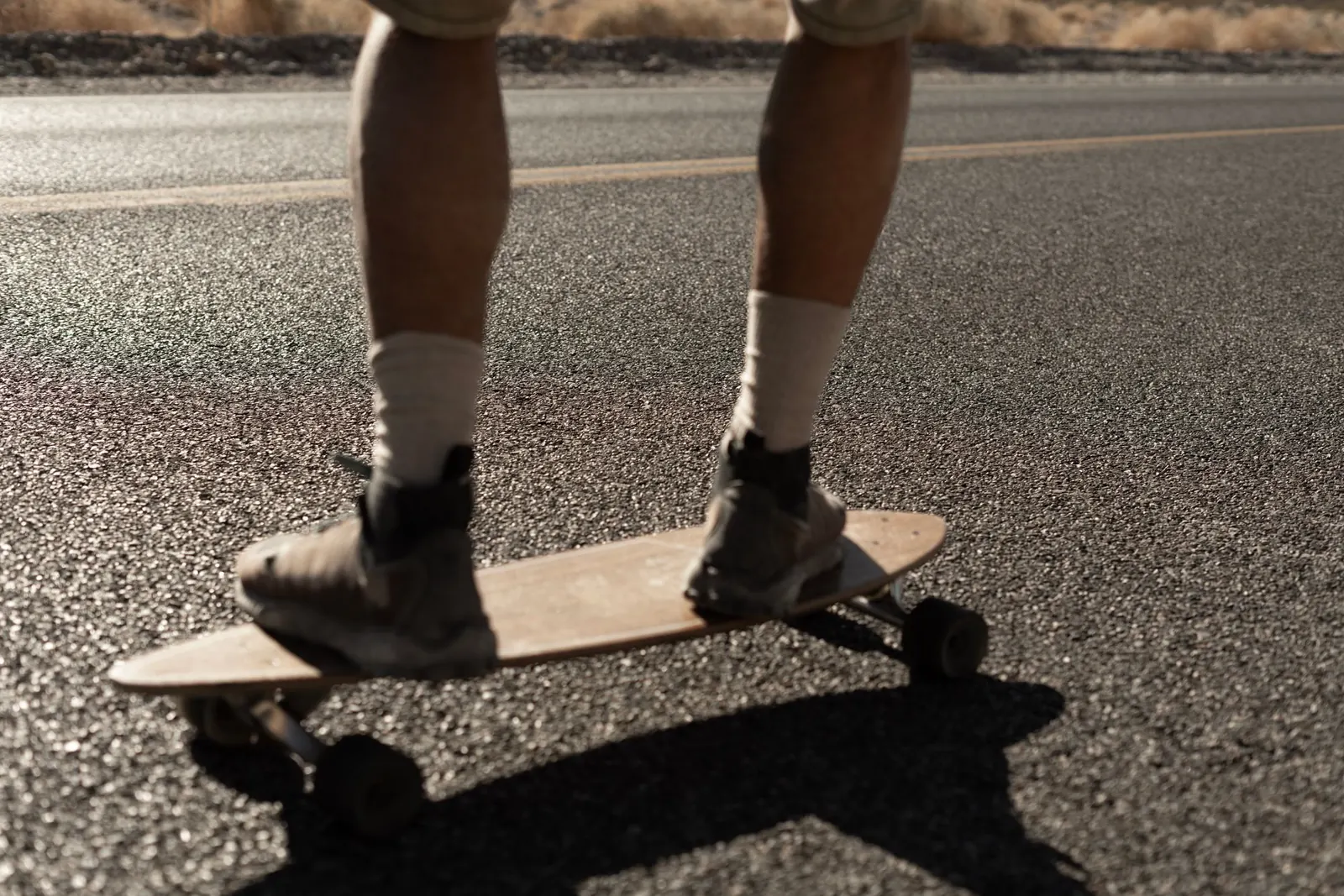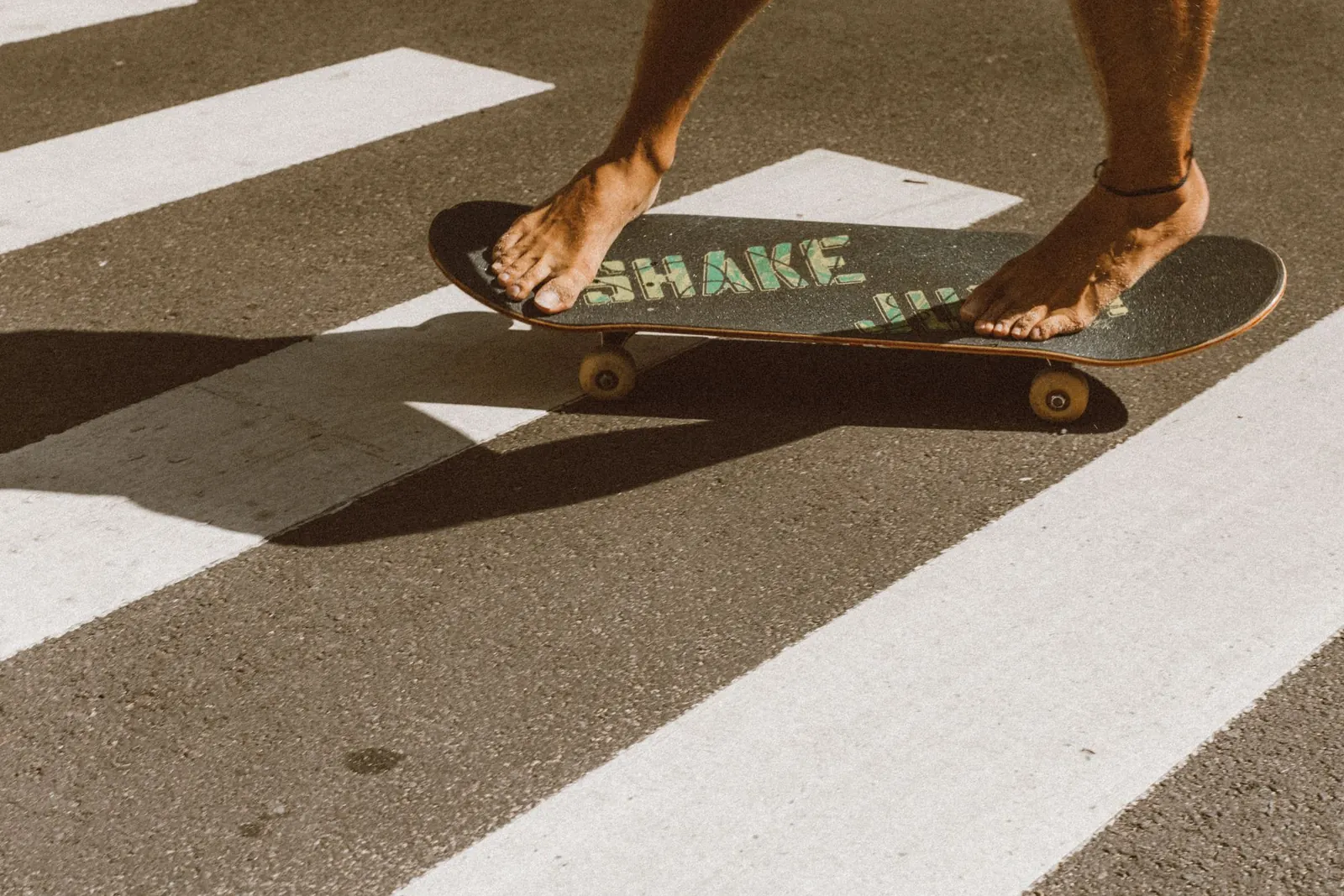
Freestyle is the playful side of longboarding. It is manuals, spins, shove-its and quick footwork, all on flat ground. The right board makes those moves feel possible. The wrong one makes them feel like wrestling a door.
Here is the short answer. The best longboard for freestyle has a kicktail at one or both ends, a symmetrical shape, a little flex and a deck of about 38 to 46 inches. Those four things give you pop, balance and room to move.
This guide explains each feature in plain English, shows how freestyle differs from dancing and freeride, and gives you three boards to look at, from budget to premium.
Quick answer
Kicktails, a symmetrical shape and a little flex
Look for a deck of about 38 to 46 inches. Shorter is easier to flip and spin. Longer gives more room for footwork.
- 📏 Length: 38–46 in
- 🔄 Same shape both ends
- 🤸 Kicktails front and back
- 🌀 Medium flex
What makes a longboard good for freestyle?
Freestyle asks a board to do things a normal cruiser never has to. You will press on the tail to lift the nose. You will ride backwards. You will hop a few inches and land again. So the board needs four things.
- Kicktails. An upturned end you can press on. Without one, most freestyle tricks are off the table.
- A symmetrical shape. If the board is the same at both ends, it rides the same in both directions. That matters every time a trick turns you around.
- A little flex. Flex cushions landings and gives a springy feel. Too much makes the board vague. Too little makes landings harsh.
- The right length. About 38 to 46 inches. Shorter boards are lighter and easier to spin. Longer boards give you space for steps.
| Feature | Look for | Why it matters |
|---|---|---|
| Kicktails | One at each end if possible | Lets you lift, pivot and pop the board |
| Shape | Symmetrical (also called twin) | Rides the same forwards and backwards |
| Length | 38–46 in | Balances spin speed against foot room |
| Flex | Medium | Cushions landings without feeling mushy |
| Wheels | 60–70 mm, 78A to mid 80s | Small and light, with enough slip for pivots |
| Weight | As light as your budget allows | A lighter board is easier to flip and catch |
💡 New to longboarding?
Learn to push, turn and stop on any stable board first. Freestyle is much easier once riding in a straight line feels boring.
Freestyle vs dancing vs freeride: what is the difference?
These three words get mixed up all the time. They overlap, but they are not the same, and the best board for each is different.
| Style | What you do | Typical board | Typical length |
|---|---|---|---|
| Freestyle | Tricks on flat ground: manuals, shove-its, spins | Light, symmetrical, with kicktails | 38–46 in |
| Dancing | Walking, cross-stepping and spinning on a rolling board | Very long, flexible platform with mellow kicks | 42–50 in |
| Freeride | Sliding the board sideways to control speed on hills | Stiff and symmetrical, with grippy concave | 38–42 in |
Freestyle and dancing blend into each other. Many riders do both in one run, stepping along the deck and then popping a trick off the tail. That is why you will see boards sold as “dancing and freestyle” boards.
Freeride is the odd one out. It happens at speed, on hills, and it needs slide gloves and real experience. A freestyle board is not a freeride board, even if a product listing uses both words.
So which should you pick? If tricks excite you most, lean shorter and lighter. If flowing footwork excites you most, lean longer. If you are not sure, a board of about 42 to 44 inches with two kicktails does a fair job of both.
The features that matter, explained
Kicktails: the engine of freestyle
A kicktail is an upturned end of the deck. Press your back foot on it and the front wheels lift. That one movement is the start of almost every freestyle trick.
Look at the angle and the length. A short, steep kick gives sharp pop for jumping tricks. A long, mellow kick is gentler and better for manuals and smooth pivots. Dancing-style boards usually have mellow kicks. Trick-focused boards usually have steeper ones.
One kicktail is enough to start. Two is better, because you can do the same trick in either direction.
Shape and length
A symmetrical board, often called a twin, has the same outline at the nose and the tail. After a half spin you are still on a board that feels normal. On a pintail you would be riding it backwards.
Length is a trade-off. Every extra inch adds weight and swing, which makes spins slower. But every extra inch also adds standing room. Riders who love shove-its often choose 38 to 42 inches. Riders who mix in dance steps often choose 44 to 46.
Flex
Flex is how much the deck bends under you. For freestyle, medium flex is the sweet spot. It softens landings and gives a lively feel when you carve between tricks.
Flex depends on your weight. A deck that feels medium to a 140 lb rider feels soft to a 210 lb rider. Premium brands often sell the same board in two flex ratings for this reason. Always check which one matches you.
Rocker, camber and concave
Product pages use three shape words that are worth knowing.
- Rocker means the deck dips slightly in the middle, like a shallow bowl. Your feet settle into it, which feels secure. Many dancing and freestyle boards have a mild rocker.
- Camber is the opposite. The middle arches up a little and flattens when you stand on it. It adds spring and energy.
- Concave is the curve from edge to edge. A mild concave lets your feet move freely for steps. A deep concave locks your feet in, which suits sliding more than freestyle.
How the trucks are mounted
Most freestyle boards are top-mount. The deck sits on top of the trucks, which gives you more leverage over the kicktails and more pop. Drop-through boards sit lower and feel steadier, but the lower height takes some snap out of tail tricks.
Wheels and trucks
Freestyle wheels are smaller and often firmer than cruising wheels. Something around 60 to 70 mm keeps the weight down. A hardness of 78A grips well and suits rough ground. A hardness in the low to mid 80s lets the wheels slip a little, which helps with pivots and slide-style tricks.
For trucks, standard reverse kingpin trucks of 150 to 180 mm work well. Match them to your deck width so the wheels sit roughly in line with the edges of the board.
📌 Grip tape matters too
Many freestyle and dancing boards use coarse grip near the ends and lighter grip in the middle. That gives your feet a firm hold for tricks and lets them slide for steps.
Budget vs premium: what does more money buy?
Freestyle boards have one of the widest price gaps in longboarding. A budget dancer can cost a fraction of a premium one. Here is what actually changes.
| Part | Budget board | Premium board |
|---|---|---|
| Deck material | Maple, or bamboo over maple | Bamboo with fiberglass or other composites |
| Weight | Heavier | Lighter, which makes tricks easier |
| Flex | One flex for everyone | Two or more flex options by rider weight |
| Shape detail | Simple kicks, little rocker | Tuned kick angles, rocker and concave |
| Trucks and wheels | Unbranded | Named brands, easier to service and replace |
Does that mean you need a premium board? No. A budget board is a fine way to find out whether you enjoy freestyle. The basics feel the same on any board with a kicktail.
The difference shows up later. Once you are landing tricks, a lighter board with the right flex is simply easier to throw around. Many riders start cheap and upgrade when they know what they like.
Our picks: 3 freestyle longboards to consider
These three boards cover three budgets and three takes on freestyle: a premium dancer, a budget dancer with two kicktails, and a compact trick board.
🔎 How we chose these
We picked these boards by the specifications listed on Amazon and by how well they fit the job. We have not ride-tested them, and we do not show prices or star ratings because they change often. Specs were checked in October 2026, so confirm the details on the product page before you buy. LongboardHub earns from qualifying purchases as an Amazon Associate, at no extra cost to you. Read our affiliate disclosure.
🏆 Best premium pick
Loaded Tarab II
Best for: Committed riders who want a purpose-built dancing and freestyle board.
Loaded describes the Tarab II as an advanced dancing platform that also suits freestyle and carving. The symmetrical deck has rocker, concave, mellow kicktails and grab rails.
- Width 9.5 in
- Deck Bamboo, symmetrical, rocker, mellow kicktails
- Trucks Paris 180 mm, 50°
- Wheels Orangatang Fat Free 65 mm, 86a
- Bearings Loaded Jehu V2
- Flex Two options by rider weight
✅ Why it works
- A long, symmetrical deck gives room for dance steps.
- Mellow kicktails at both ends suit freestyle tricks.
- Firmer 86a wheels balance grip and slide, according to the listing.
- A damp flex is tuned for dancing.
⚠️ Keep in mind
- The listing marks its skill level as advanced.
- It is one of the most expensive boards in this guide.
- The listing’s details table does not give the deck length.
Buy from Amazon Price and stock are shown on Amazon. Specs are from the Amazon listing, checked October 2026.
💰 Best budget pick
Magneto Dancer Longboard (46 in)
Best for: Riders who want two kicktails and a long platform without a premium price.
A 46-inch dancer with a kicktail at each end. The listing says the flexible deck adds bounce, and the dual kicktails are there for shove-its and manuals.
- Length 46 in
- Width 9.5 in
- Deck Bamboo and carbon fiber, dual kicktails, slight camber
- Wheels 70 mm, 78A
- Listed weight limit 275 lb
✅ Why it works
- Dual kicktails open up freestyle tricks.
- A long 46-inch platform suits dancing steps.
- The listed 275 lb weight limit is higher than many budget boards.
⚠️ Keep in mind
- The listing marks its skill level as intermediate to advanced.
- The listing is unclear about how the trucks are mounted.
- A 46-inch board is hard to carry and store.
Buy from Amazon Price and stock are shown on Amazon. Specs are from the Amazon listing, checked October 2026.
⚡ Best compact pick
Loaded Omakase (33.5 in)
Best for: Riders who want a short, wide board with a big kicktail for tricks and city riding.
Loaded calls the Omakase short, wide, stable and nimble. At 33.5 inches it is compact, but the 10-inch width keeps a solid feel underfoot.
- Length 33.5 in
- Width 10 in
- Deck Bamboo core with fiberglass, kicktail, rocker
- Trucks Paris 165 mm, 50°
- Wheels Orangatang 75 mm
✅ Why it works
- A 10-inch-wide deck feels stable despite the short length.
- A big kicktail gives pop, leverage and control.
- Rocker and mild concave hold your feet in place.
- Wheel well flares add clearance for 75 mm wheels.
⚠️ Keep in mind
- It costs several times more than a budget complete.
- A 33.5-inch board is livelier than a 40-inch one.
- Stock was low when we checked, so availability may vary.
Buy from Amazon Price and stock are shown on Amazon. Specs are from the Amazon listing, checked October 2026.
| Product | Length | Kicktails | Best for | Amazon |
|---|---|---|---|---|
| Loaded Tarab II | Not given in the listing table | Two, mellow | Dancing and freestyle | View on Amazon |
| Magneto Dancer 46 | 46 in | Two | Budget dancing and tricks | View on Amazon |
| Loaded Omakase | 33.5 in | One, large | Compact tricks and commuting | View on Amazon |
Which one should you choose?
- You are sure freestyle and dancing are your thing: the Loaded Tarab II, in the flex that matches your weight.
- You want to try it without spending much: the Magneto Dancer.
- You want tricks plus an everyday city board: the Loaded Omakase.
How to choose your freestyle board in 5 steps
- Decide between tricks and footworkWhich videos make you want to ride? If it is spins and shove-its, you want a trick-leaning board. If it is smooth stepping, you want a dance-leaning one.
- Pick a lengthChoose 38 to 42 inches for mostly tricks. Choose 44 to 46 inches if you also want room for dance steps.
- Match the flex to your weightIf the board comes in more than one flex, read the weight range for each. Heavier riders need the stiffer option.
- Check the kicktailsTwo kicktails are ideal. Look at a side-on photo to see how steep they are.
- Check the weight limitFind the listed weight limit and make sure it sits comfortably above your weight. Landings put extra load on a deck.
This order starts with what you want to do, then narrows the board to fit your body. It stops you buying a beautiful 46-inch dancer when what you really wanted was a nimble trick board.
First freestyle tricks to learn, in order
You do not need a long list. These five build on each other. Practise on smooth, flat ground at walking speed.
- KickturnPress lightly on the tail so the front wheels lift an inch, then swing the nose a little to one side. Start with tiny turns.
- Riding switchRide with your other foot forward. It feels awkward at first. Many tricks end with you facing the other way, so this pays off quickly.
- ManualShift your weight back until the front wheels hover, and hold it while you roll. Aim for one second, then two.
- Cross-stepWalk toward the nose by crossing your back foot over your front foot, then step back again. Keep your knees soft.
- Shove-itScoop the tail so the board spins half a turn under you while you hop, then land on it. Learn it standing still first.
🛡️ Wear a helmet every ride
A helmet is the one piece of gear that is not optional. Wrist guards, knee pads and elbow pads are well worth it while you learn. Freestyle falls are usually low-speed slips where your hands go out first, so wrist guards earn their keep. See our safety guides.
Real-life examples: which board would they choose?
The riders below are made-up examples, based on the kind of questions people often ask in longboarding groups and forums. They are not real people or reviews. See which one sounds most like you.
The trick learner
Dev, 5′8″, 150 lb
Dev already skates street and wants shove-its and manuals on something bigger and smoother.
Good choice: a lighter board of 38 to 42 inches with two steeper kicktails. A shorter board spins faster and is easier to catch.
The flow rider
Lena, 5′5″, 130 lb
Lena loves dance videos and wants to mix cross-steps with a few simple tricks.
Good choice: a 44 to 46 inch symmetrical board with mellow kicks, in the softer flex if two are offered.
The heavier rider
Marcus, 6′1″, 225 lb
Marcus worries that a flexible board will sag under him.
Good choice: the stiffer flex option, with a listed weight limit comfortably above 225 lb. Flex is rated by rider weight for exactly this reason.
Notice that none of them chose by graphic or by brand. Each one started with what they wanted to do, then checked length, kicktails and flex.
Common mistakes (and how to fix them)
❌ Buying a pintail for freestyle
A pintail has no kicktail and only works in one direction.
✅ The fix: Choose a symmetrical board with at least one kicktail.
❌ Going too long too soon
A 46-inch board is heavy and slow to spin. It can make first tricks feel impossible.
✅ The fix: If tricks are your main goal, start at 38 to 42 inches.
❌ Ignoring flex ratings
The wrong flex for your weight feels either dead or mushy.
✅ The fix: Check the weight range next to each flex option before you order.
❌ Keeping big, soft cruising wheels
Large soft wheels add weight and grip hard, which fights pivots.
✅ The fix: Try wheels of 60 to 70 mm, and a slightly firmer hardness once you are comfortable.
❌ Skipping the basics
Tricks on a moving board need solid balance first.
✅ The fix: Spend your first weeks on pushing, turning, stopping and riding switch.
Pro tips for learning faster
- Learn everything stationary firstPut the board on grass or carpet so it cannot roll. Get the foot movement right, then take it to pavement.
- Film yourselfA ten-second phone clip shows what your feet are really doing. It is the fastest way to spot a mistake.
- Loosen the trucks a littleSlightly looser trucks make pivots and carving between tricks smoother. Adjust a quarter turn at a time.
- Mark your foot positionsA strip of tape on the deck where your feet should land helps you build consistent habits.
- Practise both directionsDo each trick regular and switch from the start. It is slower at first and far better in the long run.
Freestyle rewards patience more than bravery. Ten calm minutes a day beats one wild hour a week.
Frequently asked questions
What is the best longboard for freestyle?
The best freestyle longboard is symmetrical, has a kicktail at one or both ends, has medium flex and is about 38 to 46 inches long. Shorter boards suit tricks. Longer boards suit a mix of tricks and dance steps.
Can you do freestyle on a drop-through longboard?
You can do simple moves, but it is harder. Drop-through boards sit lower and often have small kicktails or none, so they give less pop. A top-mount board with kicktails is the better tool.
Is freestyle the same as longboard dancing?
No, but they overlap. Dancing is footwork such as cross-steps and spins on a rolling board. Freestyle is tricks such as manuals and shove-its. Many riders combine both on one board.
What size longboard is best for freestyle tricks?
About 38 to 42 inches suits riders who mainly want tricks, because a shorter board is lighter and spins faster. About 44 to 46 inches suits riders who also want room for dance steps.
Are freestyle longboards good for beginners?
They can be, as long as you learn the basics first. A board with kicktails is a little livelier than a plain cruiser, so spend your first weeks on pushing, turning and stopping before you try tricks.
Your freestyle board checklist
Run through this list before you buy. A board that ticks every box will not hold you back.
- It has a kicktail, ideally one at each end.
- The shape is symmetrical, so it rides the same both ways.
- The length matches my goal: 38 to 42 in for tricks, 44 to 46 in for tricks and steps.
- The flex matches my weight.
- The listed weight limit is comfortably above my weight.
- The wheels are 70 mm or smaller.
- It is light enough for me to lift and flip.
- I have a helmet and wrist guards.
That is the whole recipe. The best longboard for freestyle is symmetrical, has kicktails, flexes a little and fits your size. Get those right, start with the simple tricks, and the rest comes with practice.
Still deciding?
Not sure which riding style suits you? Our free tools can point you in the right direction.
Try the free Size Guide Take the Match Quiz Back to our picks
Product specs and availability were checked in October 2026 and can change. Always confirm the details on the product page before you buy.