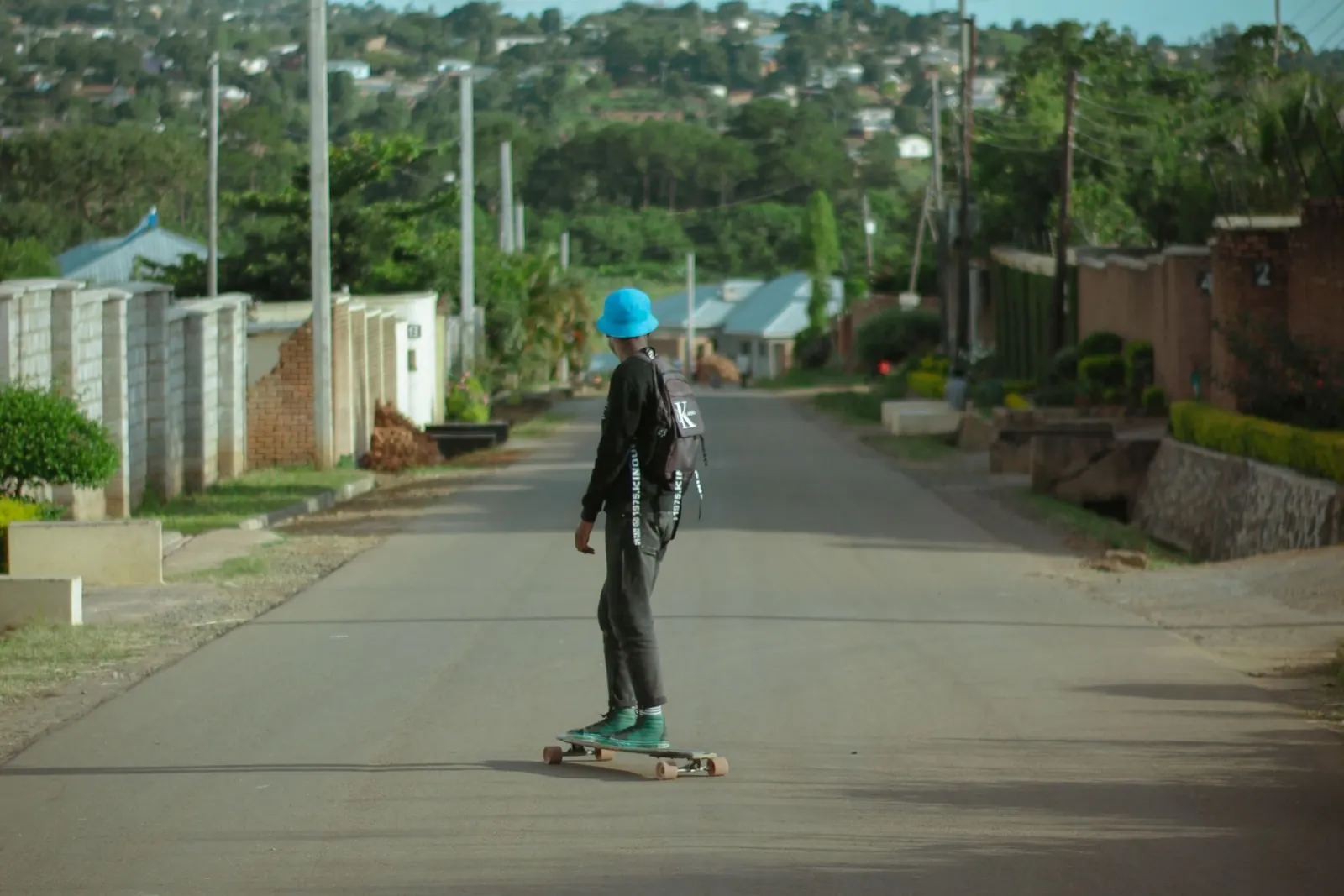
A short ride forgives almost any board. A long ride does not. After five miles, every small flaw in your setup shows up in your knees, your feet and your mood.
Here is the short answer. The best longboard for long distance has a low standing platform, big soft wheels and a stable, fairly stiff deck. Low saves your legs. Big wheels keep you rolling. Stable keeps you relaxed.
This guide explains why each of those matters, compares the deck types for distance, and gives you three boards to look at. It also covers the pushing habits that make a long ride feel easy.
Quick answer
Low deck, big wheels, stable ride
The lower you stand, the less your standing leg has to bend on every push. Over thousands of pushes, that is the difference between tired and fine.
- ⬇️ Low platform
- 🛞 Wheels: 75 mm and up
- 📏 Length: 36–42 in
- 🧱 Stiff to medium flex
What makes a longboard good for long distance?
Long-distance riding is mostly pushing. Riders call it long distance pushing, or LDP for short. You push, glide, push again, for miles. So the best board is the one that wastes the least of your effort.
- A low platform. This is the big one. A low deck means a shallow knee bend on each push.
- Big wheels. Larger wheels hold their speed longer and roll over cracks and rough patches.
- A stable ride. A long wheelbase and calm trucks let you relax instead of steering constantly.
- A comfortable deck. You will stand on it for an hour or more. Room for your feet and a little give in the deck both help.
- Low weight. A lighter board is easier to push up to speed, and easier to carry when you stop.
| Feature | Look for | Why it matters |
|---|---|---|
| Ride height | As low as possible | Less knee bend on every push |
| Wheels | 75 mm or larger, around 77A to 80A | More momentum and a smoother ride |
| Deck type | Drop deck, double drop or bracket mount | These sit lowest |
| Length | 36–42 in | Long enough to be calm, short enough to carry |
| Flex | Stiff to medium | A soft deck soaks up some of your push |
| Weight limit | Comfortably above your weight | Long rides load the deck for a long time |
Why a low deck matters so much
Stand on a kerb and tap the road with one foot. Now stand on the road and do the same. The second one is easier, because your standing leg barely bends.
That is the whole idea. On a tall board, your standing leg does a small one-legged squat every time you push. On a low board, it hardly bends at all. One push makes no difference. Two thousand pushes make a huge difference.
A low deck also helps with foot braking. Your braking foot reaches the ground sooner and with more control. On a long ride you will brake many times, so this adds up as well.
On a distance ride, your standing leg works harder than your pushing leg. A low board is a gift to that leg.
There is one trade-off. A very low deck has less ground clearance. It can scrape on speed bumps, steep driveways and tall kerbs. For most riders the saving in effort is well worth it, but it is worth knowing before you buy.
Deck types ranked for distance
How a deck is built and mounted decides how high you stand. Here are the main types, from tallest to lowest.
| Deck type | How it works | Ride height | Good for distance? |
|---|---|---|---|
| Top-mount | Deck sits on top of the trucks | Tallest | ⚠️ Tiring on long rides |
| Drop-through | Trucks mount through holes in the deck | Lower | ✅ A solid choice |
| Drop deck | Standing area dips below the truck mounts | Low | ✅ Very good |
| Double drop | Drop deck with drop-through mounting | Very low | ✅ Excellent |
| Bracket mount | Trucks sit on brackets beyond the deck ends | Lowest | ✅ Built for it |
A top-mount board is great for carving, but it stands tall. Fine for a mile or two. Hard work for ten.
A drop-through is the common middle ground. It is lower than a top-mount, widely available and affordable. Many people ride long distances on one quite happily.
A drop deck shapes the wood so your feet sit lower than the trucks. A double drop adds drop-through mounting on top of that. Both are noticeably easier on the legs.
A bracket mount is the specialist option. The trucks bolt to metal brackets that extend past the ends of the deck, so the platform can sit only a little above the road.
Wheels for long distance
Wheels matter almost as much as ride height. Three things count: size, hardness and clearance.
Size
A bigger wheel carries more momentum, so you glide further between pushes. It also climbs over cracks and pebbles that would catch a small wheel. For distance, 75 mm is a good starting point, and many riders go to 80 or 85 mm. Specialist setups use wheels of 100 mm or more.
Hardness
Wheel hardness is shown as a number followed by the letter A. Lower numbers are softer. Soft wheels of around 77A to 80A absorb vibration, which protects your feet and legs on long rides. Harder wheels roll a little faster on perfect pavement, but they pass every bump on to you.
Clearance
Big wheels need room. If a wheel touches the deck in a turn, it stops dead. This is called wheel bite, and it can throw you off. Boards made for big wheels have cutouts or shaped wheel wells. If you fit bigger wheels to a board that was not designed for them, check the clearance before you ride.
| Wheel size | Feels like | Best for |
|---|---|---|
| 70 mm | Quick to accelerate, feels rough roads more | Rides under about 3 miles |
| 75–80 mm | Smooth, holds speed well | Most distance riding |
| 85 mm and up | Rolls over almost anything, heavier | Long rides on rough or mixed surfaces |
Trucks, bearings and setup for distance
Once the deck and wheels are right, a few small setup choices make long rides more comfortable.
- Trucks. You want calm, predictable steering. If the board feels twitchy, tighten the large nut on each truck a quarter turn. If it will not turn enough to follow a path, loosen it a quarter turn.
- Bearings. Clean, lightly lubricated bearings roll further than dirty ones. That matters more than any rating printed on the box. Clean them when the wheels start to sound gritty.
- Shoes. Flat, firm soles give the best feel for the board and last longer under foot braking. Soft running shoes wear through quickly.
- Grip tape. Standing in one position for a long time can make your front foot ache. Some distance riders use a smoother grip in the middle of the deck so they can shift their feet easily.
None of these costs much. Together they can make the difference between a ride you finish and a ride you enjoy.
Our picks: 3 longboards for long distance
These three cover three budgets and three ways of getting low: a bracket-mounted specialist, a budget drop deck, and a long drop-through with large wheels.
🔎 How we chose these
We picked these boards by the specifications listed on Amazon and by how well they fit the job. We have not ride-tested them, and we do not show prices or star ratings because they change often. Specs were checked in October 2026, so confirm the details on the product page before you buy. LongboardHub earns from qualifying purchases as an Amazon Associate, at no extra cost to you. Read our affiliate disclosure.
🏆 Best specialist pick
Loaded Fathom (33 in)
Best for: Riders who want a purpose-built commuting and distance board and are happy to pay for it.
The Fathom mounts its trucks on brackets beyond the ends of the deck, so the platform sits very low. Loaded pairs that with very large wheels and describes the result as easy to ride and built to hold commuting speeds.
- Length 33 in
- Width 9.5 in
- Deck 8-ply maple, slight camber, bracket mounting
- Trucks Paris 150 mm
- Wheels 105 mm or 85 mm Orangatang
- Listed weight limit 250 lb
✅ Why it works
- The low ride height makes pushing and foot braking easier.
- Wheels of 85 mm or 105 mm carry momentum and roll over rough ground.
- A slight camber adds suspension, according to the listing.
⚠️ Keep in mind
- It is one of the most expensive boards in this guide.
- The listed weight limit is 250 lb.
- Choose between the two wheel setups on the listing.
Buy from Amazon Price and stock are shown on Amazon. Specs are from the Amazon listing, checked October 2026.
💰 Best budget pick
Shape illustration, not a product photo
Atom Drop Deck Longboard (41 in)
Best for: Riders who want a very low platform at a low price.
A drop deck lowers the standing platform below the truck mounts. That puts you very close to the ground, which makes pushing easy and gives a planted feel.
- Length 41 in
- Width 9 in
- Deck Maple laminate, drop deck
- Trucks Reverse kingpin, 245 mm axles
- Wheels 70 x 51 mm
- Bearings ABEC 9
- Listed weight limit 220 lb
✅ Why it works
- The very low platform saves your legs on long pushes.
- A 41-inch deck on wide axles feels steady.
- Grippy 80S grip tape is listed.
⚠️ Keep in mind
- The listing does not give a clear wheel hardness.
- The listed weight limit is 220 lb.
- A very low deck has less ground clearance over kerbs and speed bumps.
Buy from Amazon Price and stock are shown on Amazon. Specs are from the Amazon listing, checked October 2026.
🏃 Best all-rounder
Shape illustration, not a product photo
Sector 9 Lookout Talon Complete (41.1 in)
Best for: Riders who want one board for distance, commuting and relaxed carving.
The Lookout is Sector 9’s long-running drop-through shape. This version uses a bamboo and maple hybrid deck with a long 31.5-inch wheelbase, and the listing gives its riding style as carving and commuting.
- Length 41.125 in
- Width 9.625 in
- Wheelbase 31.5 in
- Deck Bamboo and maple hybrid, drop-through
- Trucks 10 in Gullwing Charger
- Wheels 72 mm, 78a Nineballs
- Bearings ABEC 5 Greaseball
✅ Why it works
- A 31.5-inch wheelbase is long and calm.
- Bamboo and maple hybrid construction adds a little flex.
- Large 72 mm, 78a wheels suit rough pavement.
- Branded Gullwing trucks are fitted.
⚠️ Keep in mind
- The listing marks its skill level as intermediate.
- The listing does not give a weight limit.
- Stock was low when we checked, so availability may vary.
Buy from Amazon Price and stock are shown on Amazon. Specs are from the Amazon listing, checked October 2026.
| Product | Deck type | Wheels | Best for | Amazon |
|---|---|---|---|---|
| Loaded Fathom | Bracket mount | 85 or 105 mm | Long commutes and distance | View on Amazon |
| Atom Drop Deck 41 | Drop deck | 70 mm | Low-cost distance pushing | View on Amazon |
| Sector 9 Lookout 41 | Drop-through | 72 mm, 78a | Distance plus everyday riding | View on Amazon |
Which one should you choose?
- You ride far and often: the Loaded Fathom is the one built for the job.
- You want to try distance riding cheaply: the Atom Drop Deck gets you low for much less.
- You want one board for everything: the Sector 9 Lookout is longer, turns more easily and still pushes well.
How to choose your distance board in 5 steps
- Work out your usual distanceUnder three miles, most stable boards work. Over five, ride height and wheel size start to matter a lot.
- Pick the lowest deck type you canA drop deck or double drop is the best value. A drop-through is fine if you also want to carve.
- Choose your wheelsAim for 75 mm or bigger if the board has room for them. Stay around 77A to 80A for comfort.
- Check the size and weight limitUse your height to pick a length, and make sure the listed weight limit sits comfortably above your weight.
- Think about carrying itLong rides often end with stairs, a shop or a train. A lighter, shorter board is easier to live with.
Notice that ride height comes before everything else. Wheels can be swapped later for a modest cost. Ride height is built into the deck.
Not sure what length suits your height?
How to push further with less effort
The board is only half the story. These habits make any board go further.
- Learn to push with both legsSwap your pushing leg every few minutes. It feels clumsy at first. It halves the load on each leg, and it is the single most useful distance skill.
- Use long, smooth pushesOne long push that sweeps back past your standing foot is better than three short stabs. Let the board glide before you push again.
- Stay looseKeep your standing knee soft and your shoulders relaxed. A stiff body tires quickly and wobbles more.
- Brake earlySlow down well before junctions with a gentle foot brake. Hard, late braking wears your shoe and your nerves.
- Pace yourselfStart slower than you think you need to. A steady rhythm you can hold for an hour beats a sprint you can hold for five minutes.
What to carry on a long ride
- Water, and a snack for anything over an hour.
- A skate tool, so you can tighten a loose truck or wheel nut.
- A phone with your route saved.
- Lights or reflective gear if there is any chance of riding at dusk.
- A little cash or a card, in case you need to take a bus home.
🛡️ Wear a helmet every ride
A helmet is the one piece of gear that is not optional. Wrist guards, knee pads and elbow pads are well worth it while you learn. On long rides you share space with traffic, dogs and tired legs, so do not skip it. See our safety guides.
Real-life examples: which board would they choose?
The riders below are made-up examples, based on the kind of questions people often ask in longboarding groups and forums. They are not real people or reviews. See which one sounds most like you.
The fitness rider
Carlos, 5′10″, 180 lb
Carlos wants to ride ten miles of riverside path at weekends as exercise.
Good choice: a drop deck or double drop with wheels of 75 mm or more. At that distance, a low platform matters more than anything else.
The long commuter
Aisha, 5′4″, 135 lb
Aisha rides four miles each way to work, on a mix of bike lanes and rough side streets.
Good choice: a low board of about 38 to 40 inches with soft 75 to 85 mm wheels. Big soft wheels deal with the rough streets, and the shorter length is easier to carry indoors.
The weekend explorer
Tom, 6′2″, 210 lb
Tom wants one board for relaxed 3 to 5 mile rides and some carving on quiet roads.
Good choice: a 41 inch drop-through with 70 to 75 mm wheels, with a weight limit comfortably above 210 lb. It pushes well and still turns nicely.
Common mistakes (and how to fix them)
❌ Choosing a tall top-mount for long rides
Every push becomes a small squat. It feels fine for a mile and miserable after five.
✅ The fix: Pick a drop-through at least, and a drop deck if distance is your main goal.
❌ Riding small, hard wheels
Small wheels lose speed quickly and hard wheels shake your feet.
✅ The fix: Fit soft wheels of 75 mm or more, as long as your board has the clearance.
❌ Pushing with one leg only
One leg does all the work while the other does all the standing. Both get sore.
✅ The fix: Practise switching legs on short rides until it feels normal.
❌ Fitting big wheels without checking clearance
A wheel that touches the deck stops instantly.
✅ The fix: Turn the board hard by hand and check the gap before you ride. Add risers if needed.
❌ Going too far too soon
A ten-mile ride on untrained legs is a long walk home.
✅ The fix: Build up by a mile or two each week.
Frequently asked questions
What is the best longboard for long distance?
The best longboard for long distance has a low platform, such as a drop deck, double drop or bracket-mounted deck, with soft wheels of 75 mm or more. A low deck reduces how far your standing leg bends on every push, which saves energy over many miles.
What size wheels are best for long-distance longboarding?
Wheels of 75 to 85 mm suit most distance riding. They hold speed well and roll over cracks. A hardness of about 77A to 80A keeps the ride comfortable.
Is a drop-through longboard good for long distance?
Yes. A drop-through is lower than a top-mount board and is a good, affordable choice. A drop deck or double drop sits lower still and is easier on the legs for very long rides.
How far can you ride a longboard in a day?
It depends on your fitness, the route and the board. New riders are often tired after 3 to 5 miles. With practice, a low board and good pushing technique, many riders build up to much longer rides. Increase your distance gradually.
Does longboard length matter for long distance?
Length matters less than ride height and wheel size. A board of 36 to 42 inches is long enough to feel stable and short enough to carry. Choose within that range by your height.
Your long-distance board checklist
Check these before you buy, and again before your first long ride.
- The deck is low: a drop-through at least, a drop deck or lower if I can.
- The wheels are 75 mm or more, and soft.
- The wheels cannot touch the deck in a hard turn.
- The length suits my height.
- The listed weight limit is comfortably above my weight.
- I can carry the board when I need to.
- I can push with either leg.
- I have a helmet, water and a skate tool.
That is it. The best longboard for long distance keeps you low, keeps you rolling and keeps you relaxed. Get those three right, build up your miles slowly, and long rides become the best part of your week.
Still deciding?
Get a size worked out for you, or jump back to the picks.
Try the free Size Guide Take the Match Quiz Back to our picks
Product specs and availability were checked in October 2026 and can change. Always confirm the details on the product page before you buy.