In this guide
“Longboard” covers a wide family of boards. The names describe the deck shape and how the trucks are mounted, and each has strengths and trade-offs. Use this guide to match the type to how you want to ride.
Longboard types compared
| Type | Best for | Strengths | Trade-offs |
|---|---|---|---|
| Pintail | Carving, relaxed cruising | Smooth, surf-like turns, classic look | Less foot room at the pointed tail |
| Drop-through | Commuting, cruising, first boards | Low and stable, easy to push, forgiving | Less leverage for sliding, deck can flex |
| Drop-deck (double drop) | Long-distance pushing, very low ride | Very stable and comfortable to push | Bulkier, less responsive to carve |
| Top-mount | Carving, freeride, general riding | Responsive, more leverage in turns | Sits higher, can feel less stable for beginners |
| Cruiser or kicktail | Short rides, carrying, campus | Compact, light, quick to turn | Less stable at speed |
| Dancer | Dancing and freestyle | Long, flexible platform for footwork | Long to carry, not built for speed |
| Freeride | Sliding and technical riding (advanced) | Symmetrical shapes and stiff, controllable setups | Needs skill and full protective gear |
| Downhill | High-speed riding (advanced) | Stable at speed, low or stiff decks | Not for beginners, needs a controlled location |
Pintail
A pintail has a teardrop outline, typically with a rounded nose and a pointed tail. It is built for smooth, flowing turns, and for many people it is the classic cruising and carving board.

Drop-through
On a drop-through the trucks are mounted through cutouts in the deck, which brings the deck closer to the ground. A lower deck is easier to push and more stable, so drop-throughs are popular for commuting and as first boards.
Drop-deck
On a drop-deck the platform itself is lowered between the trucks. It rides very low and is comfortable for long pushes, but it is not as nimble in turns.
Top-mount
With top-mount boards the trucks bolt to the underside of the deck. The deck sits higher, which gives more leverage for carving and technical riding, but a higher ride can feel less stable at first.
Cruiser and kicktail
Cruisers are shorter, often with a kicktail, which makes them light, easy to carry and quick to turn. They are good for short rides and for getting around campus, though they feel less stable at speed.
Dancing boards
Dancers are long, often 42 inches or more, with a flexible top-mount deck that gives room for footwork such as cross-stepping and board-walking. They are for flowing, low-speed riding rather than speed.
Freeride and downhill
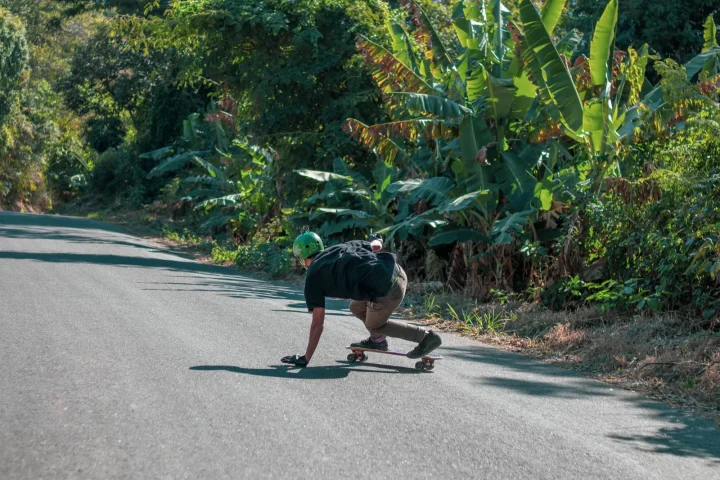
These are advanced disciplines built around control at speed and sliding. They need skill, a suitable location and full protective gear. We do not recommend them as a first board.
How to choose
- Want an easy, stable first board? A drop-through or a pintail around 38 to 42 inches suits many beginners.
- Need something to carry? Look at a compact cruiser.
- Want to carve? A pintail or a responsive top-mount.
- Want to dance? A long, flexible dancer.
Related reading: how to choose a longboard, the size guide and best longboards for beginners.
Questions about board types
What type of longboard is best for beginners?
Drop-throughs and pintails around 38 to 42 inches are the most common recommendations because they are stable and forgiving.
What is the difference between a drop-through and a drop-deck?
A drop-through has the trucks mounted through the deck. A drop-deck has the deck platform itself lowered between the trucks. Some boards combine both.
Are cruisers longboards?
Usually a cruiser is a shorter board that sits between a skateboard and a longboard. It is built for short rides and portability.