Longboard prices can be confusing. Two boards that look the same in a photo can be $60 and $360. Is the expensive one six times better? Is the cheap one a waste of money?
Here is the short answer. Most complete longboards cost between about $50 and $400. Budget boards for beginners sit at roughly $50 to $100. Mid-range boards from established brands run from about $130 to $250. Premium boards go from about $250 to more than $400.
Those ranges come from prices we saw on Amazon in October 2026. Prices change all the time, so use them as a guide. The rest of this article explains what you actually get for your money, what the hidden costs are, and how much a beginner really needs to spend.
Quick answer
About $50 to $400 for a complete board
A beginner can start well at the low end. Add the cost of a helmet before you set your budget.
- 💰 Budget: about $50–$100
- 🏆 Mid-range: about $130–$250
- 💎 Premium: about $250–$400+
- ⛑️ Plus a helmet
How much does a longboard cost?
This table shows the three main price tiers and what each one typically offers.
| Tier | Typical price | What you get | Who it suits |
|---|---|---|---|
| Budget | About $50–$100 | Maple deck, unbranded trucks and wheels, one flex | Beginners and casual riders |
| Mid-range | About $130–$250 | Better deck shaping, named trucks and wheels | Regular riders and upgraders |
| Premium | About $250–$400+ | Composite decks, flex options, top components | Riders who know their style |
| Electric | About $200–$700+ | Motor, battery and remote on top of the board | Commuters who want powered riding |
Most people buying a first board will be perfectly well served by the budget tier. The mid-range and premium tiers pay off once you ride often enough to notice the difference.
📌 About these numbers
These are approximate ranges from Amazon listings in October 2026. We do not list exact prices for individual boards, because they change often. Always check the current price on the product page.
What makes one longboard cost more than another?
A longboard has four main parts: the deck, the trucks, the wheels and the bearings. The price of the whole board follows the price of those parts, plus the work that went into designing them.
The deck
The deck is the biggest factor. A budget deck is made from layers of maple pressed into a simple shape. It is strong and heavy, and it works.
A mid-range deck adds better shaping, such as a curve across its width to hold your feet, or hollows that keep the wheels from touching the deck. Some use bamboo, which is lighter and springier.
A premium deck often combines bamboo with fiberglass or other materials. These composites are light and lively, and they cost a good deal more to make. Premium decks may also come in two stiffness options so the board suits your weight.
The trucks
Trucks are the metal parts that hold the wheels and let the board turn. Budget boards use unbranded cast trucks. They do the job but can feel vague, and the rubbery bushings inside them are often basic.
Named trucks cost more and turn more precisely. Bought separately, a pair of well-known longboard trucks was roughly $45 to $75 when we checked, against about $20 to $30 for a generic pair.
The wheels
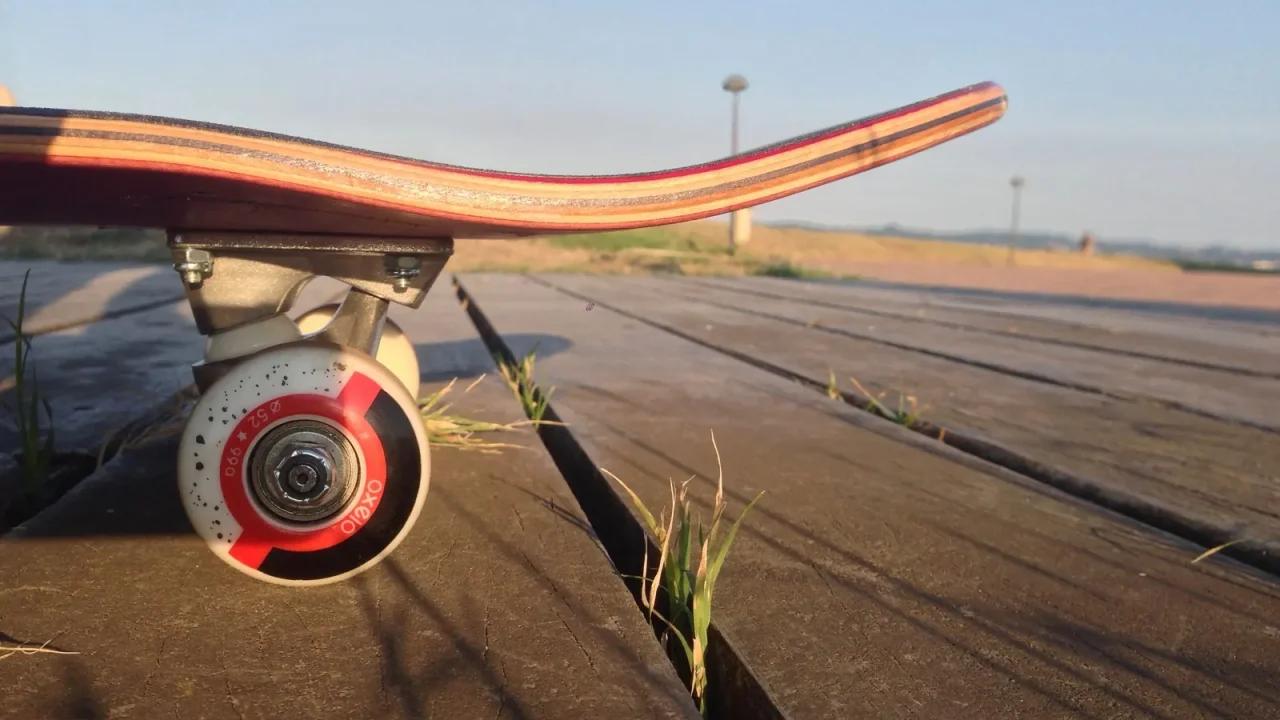
Wheels are made of urethane, and the quality of that urethane varies. Good wheels grip better, roll further and wear more evenly. When we checked, a set of four generic 70 mm wheels was about $20 to $30, while a set from a well-known wheel brand was about $60 to $70.
The bearings
Bearings sit inside the wheels and let them spin. They are the cheapest of the four parts. A set of eight well-known skate bearings was about $25 to $40 when we checked. Budget boards often advertise a high ABEC number, but that number says little about real performance.
| Part | Budget option | Named-brand option |
|---|---|---|
| Deck | About $40–$70 | Considerably more, and it varies widely |
| Trucks (pair) | About $20–$30 | About $45–$75 |
| Wheels (set of 4) | About $20–$30 | About $60–$70 |
| Bearings (set of 8) | About $10–$15 | About $25–$40 |
| Grip tape (one sheet) | About $7–$15 | About $10–$20 |
Add those up and you can see why a complete board is good value. Bought as parts, even a basic setup costs more than many budget completes.
Complete board or custom build: which costs less?
A complete is a board sold fully assembled. A custom build means buying the deck, trucks, wheels, bearings and hardware separately and putting them together yourself.
A complete is almost always cheaper. The maker buys parts in bulk and passes on some of the saving. It also arrives ready to ride, with parts that are known to fit each other.
A custom build costs more but lets you choose every part. That is worth it when you know exactly what you want. It is not worth it for a first board, when you do not yet know which parts you would choose.
💡 The smart middle path
Buy a complete, ride it, and upgrade one part at a time as you learn what you like. New bushings and new wheels are the two cheapest upgrades with the biggest effect.
The costs people forget
The board is not the whole bill. Plan for these as well.
| Item | Rough cost | Do you need it? |
|---|---|---|
| Helmet | About $25–$85 | Yes, from day one |
| Pad set (knees, elbows, wrists) | About $45–$100 | Strongly recommended while learning |
| Skate tool | About $5–$15 | Very useful |
| Replacement bearings | About $10–$40 | Eventually, sooner if you ride in the wet |
| Replacement wheels | About $20–$70 | After a lot of riding |
| Shoes | Varies | Foot braking wears soles down |
A helmet is the one item that is not optional. If your budget is $100 in total, a $60 board and a $40 helmet is a far better plan than a $100 board and no helmet.
🛡️ Wear a helmet every ride
A helmet is the one piece of gear that is not optional. Wrist guards, knee pads and elbow pads are well worth it while you learn. See our safety guides.
How much should a beginner spend?
For a first longboard, a sensible total budget is about $100 to $160. That covers a budget complete, a helmet and a basic pad set.
Why not spend more? Because you do not yet know how you like to ride. Cruising, carving, commuting and dancing all call for different boards. A stable budget board lets you find out, and you lose very little if you decide longboarding is not for you.
Why not spend less? Well below about $50, many boards start to cut corners that matter: plastic parts, hard wheels that do not roll well, and decks with low weight limits. A board that rides badly makes learning harder and less fun.
Spend a little on your first board and a lot on your second. By then you will know what the money is for.
Is a more expensive longboard worth it?
It is worth it when you can feel the difference. That usually means you ride regularly and have a clear style.
A carver will notice a springy composite deck straight away. A commuter will notice a lower platform and bigger wheels on every trip. A dancer needs a long, well-shaped deck that budget boards rarely offer.
A complete beginner will notice far less. Balance, pushing and stopping feel much the same on a $70 board as on a $350 one. So the honest answer is: not yet, but probably later.

A board to consider at each price
To make the tiers concrete, here is one drop-through board from each. We do not show prices, so check the current price on Amazon.
🔎 How we chose these
We picked these boards by the specifications listed on Amazon and by how well they fit the job. We have not ride-tested them, and we do not show prices or star ratings because they change often. Specs were checked in October 2026, so confirm the details on the product page before you buy. LongboardHub earns from qualifying purchases as an Amazon Associate, at no extra cost to you. Read our affiliate disclosure.
💰 Budget tier
Shape illustration, not a product photo
Volador Urban Freeride Pro Longboard (40 in)
Best for: First-time riders who want a light, low board for very little money.
A light 40-inch drop-through with a shallow concave deck. The listing describes it as made for urban and campus commutes and casual cruising.
- Length 40 in
- Width 9 in
- Deck 8-layer maple with epoxy resin, drop-through
- Trucks Forged reverse kingpin
- Wheels 70 mm, 78A
- Bearings ABEC-9
- Listed weight limit 220 lb
✅ Why it works
- At a listed 6.2 lb it is light for a 40-inch board.
- The drop-through deck is low and easy to push.
- Soft 78A wheels absorb vibration, according to the listing.
⚠️ Keep in mind
- The listed weight limit is 220 lb.
- The 9-inch deck is narrow for very big feet.
- It is sold in several graphics. Our link opens one of them.
Buy from Amazon Price and stock are shown on Amazon. Specs are from the Amazon listing, checked October 2026.
🏆 Mid-range tier
Shape illustration, not a product photo
Arbor Flagship Axis Complete (40 in)
Best for: Regular riders who want named trucks and a well-finished deck.
Arbor describes the Axis as a snowboard-inspired drop-through for easy cruising around town, relaxed commutes and mellow downhill. The deck is 8-ply maple with a palisander wood top and bottom.
- Length 40 in
- Width 9 in
- Deck 8-ply Canadian maple with palisander, drop-through
- Trucks Paris 180 mm, 50°
- Wheels Arbor Outlook 69 mm, 78A
✅ Why it works
- Drop-through mounting keeps it low and easy to push.
- Paris 180 mm trucks are fitted.
- Soft 69 mm, 78A wheels are described as grippy.
- Arbor says the wood comes from sustainable sources.
⚠️ Keep in mind
- The listing does not give a weight limit.
- A 9-inch deck is narrow for very big feet.
- Stock was low when we checked, so availability may vary.
Buy from Amazon Price and stock are shown on Amazon. Specs are from the Amazon listing, checked October 2026.
💎 Premium tier
Shape illustration, not a product photo
Loaded Dervish Sama (about 41 in)
Best for: Experienced riders who want a composite deck in the right flex.
Loaded describes the Dervish Sama as a drop-through carving board that also handles pumping, freestyle, freeride and commuting. Nose and tail kicks add trick options that most drop-throughs lack.
- Length 104 cm (about 41 in)
- Width 9 in
- Deck Bamboo and fiberglass, drop-through, nose and tail kicks
- Trucks Paris 180 mm, 50°
- Wheels Orangatang 75 mm, 80a
- Bearings Loaded Jehu V2
- Flex Two options by rider weight
✅ Why it works
- Drop-through mounting gives stability and easier pushing.
- Large cutouts allow deep carves without wheel bite.
- Nose and tail kicks open up freestyle moves.
- Paris trucks and Orangatang wheels are fitted.
⚠️ Keep in mind
- It costs several times more than a budget complete.
- Pick the flex that matches your weight, as the listing explains.
- Stock was low when we checked, so availability may vary.
Buy from Amazon Price and stock are shown on Amazon. Specs are from the Amazon listing, checked October 2026.
| Product | Tier | Deck | Trucks | Amazon |
|---|---|---|---|---|
| Volador Freeride 40 | Budget | 8-layer maple | Unbranded forged | View on Amazon |
| Arbor Axis 40 | Mid-range | Maple with palisander | Paris 180 mm | View on Amazon |
| Loaded Dervish Sama | Premium | Bamboo and fiberglass | Paris 180 mm | View on Amazon |
Buying used: is it a good way to save?
A used board can be a bargain, especially a mid-range or premium one. Decks and trucks last for years if they are looked after. Check these things before you pay.
- Look along the deckSight down it from one end. It should be straight, with no twist. Check the edges for layers peeling apart.
- Look for cracksSmall chips at the nose and tail are normal. Cracks near the truck mounts are a reason to walk away.
- Check the trucksThey should turn smoothly and return to centre. Bent axles or cracked baseplates are not worth fixing.
- Spin the wheelsRough or noisy bearings are cheap to replace. Wheels worn into a cone shape will need replacing too.
- Stand on itLean both ways and listen. Creaks and clicks can point to loose hardware or a failing deck.
Ways to save money on a longboard
- Buy a complete, not parts. It is nearly always cheaper.
- Ignore the graphic. The same board in a less popular design is sometimes cheaper.
- Skip features you will not use. A beginner does not need a specialist dancing or downhill board.
- Look after your bearings. Keep them dry and clean and they will last far longer.
- Upgrade in steps. New bushings or wheels can refresh an old board for a fraction of the cost of a new one.
Real-life examples: how much would they spend?
The riders below are made-up examples, based on the kind of questions people often ask in longboarding groups and forums. They are not real people or reviews. See which one sounds most like you.
The curious beginner
Jess, student
Jess wants to try longboarding and has about $120 in total.
Good choice: a budget complete at around $60 to $80, plus a helmet. That leaves a little for pads.
The daily commuter
Andre, office worker
Andre has ridden a budget board to work for a year and it is wearing out.
Good choice: a mid-range board with named trucks and wheels. He rides enough to feel the difference every day.
The keen carver
Mei, weekend rider
Mei knows she loves carving and wants a board that rewards it.
Good choice: a premium composite carving board in the right flex, bought once and kept for years.
Common mistakes (and how to fix them)
❌ Spending the whole budget on the board
That leaves nothing for a helmet.
✅ The fix: Set aside money for a helmet first, then choose the board.
❌ Buying the cheapest board you can find
Very cheap boards often have hard wheels and weak parts.
✅ The fix: Be wary of complete boards priced far below $50, and read the specs closely.
❌ Buying premium too early
You may pay for features that do not suit the way you end up riding.
✅ The fix: Ride a budget board for a season first.
❌ Paying for a high ABEC number
It has little to do with how a board rides.
✅ The fix: Judge the deck, trucks and wheels instead.
❌ Forgetting running costs
Bearings and wheels wear out.
✅ The fix: Budget a little each year for replacements.
Looking after your board
A longboard needs very little maintenance, but a few habits make it last much longer and ride much better.
- Keep it dry. Water rusts bearings and damages wooden decks. If the board gets wet, dry it and spin the wheels.
- Check the bolts. Vibration loosens truck bolts and axle nuts over time. A quick check every few weeks is enough.
- Clean the bearings when the wheels sound gritty or stop spinning freely.
- Swap the wheels around now and then, so they wear evenly.
- Replace worn bushings. Cracked or squashed bushings make a board feel sloppy, and new ones cost very little.
- Store it indoors. Heat, cold and damp all shorten the life of a deck.
For step-by-step help, see our maintenance guides.
Key terms in plain English
Longboard listings use a lot of jargon. Here are the terms used in this guide, explained simply.
| Term | What it means |
|---|---|
| Complete | A board sold fully assembled, with deck, trucks, wheels and bearings ready to ride. |
| Deck | The board you stand on. Usually made from layers of maple or bamboo. |
| Trucks | The two metal T-shaped parts under the deck. They hold the wheels and let the board turn when you lean. |
| Bushings | The rubbery rings inside each truck. Softer ones let the board lean easily. Harder ones resist. |
| Durometer | Wheel hardness, shown as a number and the letter A. Around 78A is soft and grippy. The mid 80s and above are firmer. |
| ABEC | An industrial precision scale for bearings. A higher number says little about how a skateboard bearing performs. |
| Flex | How much the deck bends under your weight. Some flex is comfortable. Stiff is steadier at speed. |
| Drop-through | A deck with holes that the trucks mount through, so the deck sits lower. |
Frequently asked questions
How much does a good longboard cost?
A good beginner longboard costs about $50 to $100 as a complete board. Mid-range boards from established brands cost about $130 to $250, and premium boards cost about $250 to more than $400. These are approximate ranges from October 2026.
How much should I spend on my first longboard?
A total budget of about $100 to $160 is sensible for a first setup. That covers a budget complete board, a helmet and a basic set of pads.
Why are some longboards so expensive?
Expensive longboards use composite decks made from materials such as bamboo and fiberglass, named trucks and wheels, and more detailed shaping. Some are offered in two flex ratings to suit different rider weights. All of that costs more to design and make.
Is it cheaper to build your own longboard?
Usually not. A complete board is nearly always cheaper than buying a deck, trucks, wheels and bearings separately. Building your own makes sense when you want to choose every part.
Are cheap longboards any good?
Budget longboards of about $50 to $100 are fine for learning and casual riding. Boards priced well below that often use hard wheels and weaker parts, which make riding harder.
Your longboard budget checklist
Work through this before you buy.
- I have set a total budget, not just a board budget.
- I have set aside money for a helmet.
- I have thought about pads and a skate tool.
- I am buying a complete board, not separate parts.
- The board is in the right tier for my experience.
- The board is the right size and has a weight limit above my weight.
- I have checked the current price on the product page.
So, how much do longboards cost? Anywhere from about $50 to more than $400. The good news is that the low end of that range is enough to start well. Buy a sensible first board, buy a helmet, and save the bigger spend for when you know exactly what you want.
Still deciding?
Want help choosing the right size or style before you spend? Try our free tools.
Try the free Size Guide Take the Match Quiz Back to our picks
Product specs and availability were checked in October 2026 and can change. Always confirm the details on the product page before you buy.