Knees take a beating in longboarding. When you fall forward, they are often the first thing to hit the road. Good knee pads turn that from a week of limping into nothing at all.
Here is the short answer. The best longboard knee pads have a hard plastic cap, enough foam to absorb an impact, and a snug fit that stays put when you slide. A pad that fits well matters more than which brand it is.
This guide explains the different types of knee pad, how to measure your knee and choose a size, and how to match a pad to the way you ride. It also suggests four options, from a slim everyday pad to a full set for beginners.
Quick answer
A hard cap, good foam and a snug fit
Measure around your knee before you buy. A pad that slips down in a fall protects nothing.
- 🛡️ Hard cap that slides
- 🧽 Foam that absorbs
- 📏 Sized by knee measurement
- 🔒 Straps that hold
What makes a good longboard knee pad?
A knee pad has one job: to take the hit so your knee does not. It does that in two ways at once.
- The foam absorbs the impact. When your knee hits the ground, the foam compresses and spreads the force over a wider area.
- The hard cap slides. A smooth plastic shell skids along the road instead of gripping it. That turns a sudden stop into a slide, which is much kinder to your joints and your skin.
A third thing ties them together: fit. If the pad shifts when you fall, the cap is no longer over your kneecap and the foam is no longer where the impact is.
| Feature | Look for | Why it matters |
|---|---|---|
| Cap | Hard plastic, firmly attached | Slides on pavement instead of grabbing |
| Padding | Dense foam, thicker for harder riding | Absorbs the impact |
| Fit | Snug, with no gaps | Keeps the pad over your kneecap in a fall |
| Closure | Sleeve, straps or open back | Decides how easy it is to put on |
| Size | Matched to your knee measurement | A loose pad slips, a tight one cuts in |
| Bulk | Low for pushing, higher for sliding | Affects comfort on long rides |
Types of knee pad
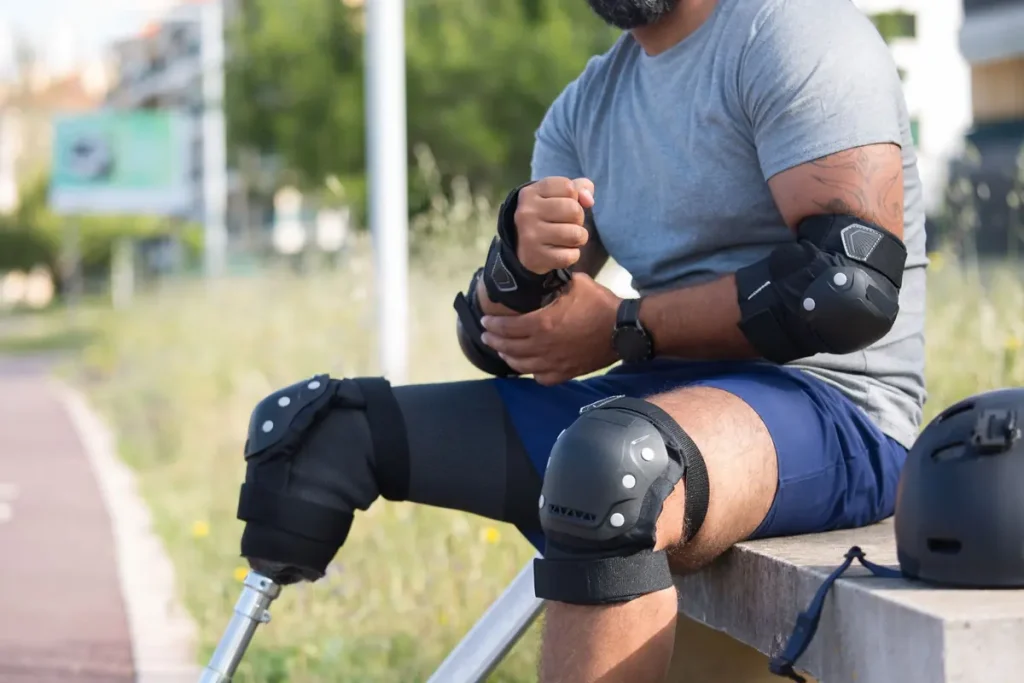
Knee pads for skating fall into a few groups. They differ in how much protection they give and how comfortable they are to wear for long periods.
| Type | Protection | Comfort | Best for |
|---|---|---|---|
| Slim hard-cap pad | Good | High, low bulk | Cruising, commuting, everyday riding |
| Full-size pro pad | Highest | Bulky and warm | Learning to slide, downhill, skateparks |
| Compact street pad | Moderate | High | Casual riding and beginners |
| Soft sleeve pad | Low | Highest | Light protection under clothing |
A slim hard-cap pad is the best fit for most longboarders. It gives real protection without getting in the way of pushing, and you can wear it for an hour without thinking about it.
A full-size pro pad has much thicker foam and a larger cap. Riders who are learning to slide, or who ride fast, wear these because they can drop onto their knees on purpose and slide to a stop.
A soft sleeve pad has no hard cap. It protects against scrapes and light knocks, and it fits under trousers. It is not a substitute for a hard-cap pad if you fall on rough tarmac.
How they fasten
- Sleeve pads pull on over your foot like a sock. They stay in place very well, but you have to take your shoes off to put them on.
- Open-back pads wrap around the leg and fasten with straps. You can put them on without removing your shoes.
- Butterfly closures open completely flat, which makes them the quickest of all to fit.
How to measure and size knee pads
Most sizing mistakes come from guessing. It takes one minute to measure properly.
- Find a soft tape measureA piece of string and a ruler works too.
- Measure around your kneeWrap the tape around the middle of your kneecap. Most makers ask for the measurement with the leg straight, but check the chart for the pad you are buying.
- Find your size on the chartEach brand has its own chart. Do not assume a medium in one brand is a medium in another.
- If you are between sizesRead the maker’s advice. As a general rule, go smaller for a secure fit if you are slim, and larger if you have muscular legs.
- Try them on at homeBend your knee fully and walk around. The pad should stay centred and should not pinch behind the knee.
To show how much charts vary, here are the ranges from two listings we checked. They are examples only. Always use the chart on the product page.
| Size | 187 Killer Pads Fly (around the knee) | Triple Eight Street (around the knee) |
|---|---|---|
| Extra small | 10–12 in | 11–12.5 in |
| Small | 12–14 in | 12.5–14.5 in |
| Medium | 14–16 in | 14.5–16 in |
| Large | 15–17 in | 16–17 in |
| Extra large | 17–20 in | Not offered |
📌 The fit test
Kneel on a carpet with the pads on and shuffle forward. If a pad slides down or twists, it is too loose or the straps need tightening.
Which knee pads suit your riding?
The right pad depends on how fast you go and how you are likely to fall.
| How you ride | Pad to choose | Why |
|---|---|---|
| Learning the basics | A compact pad or a full pad set | Low-speed falls, and you need wrists and elbows covered too |
| Cruising and commuting | A slim hard-cap pad | Comfortable enough to wear every ride |
| Dancing and freestyle | A slim hard-cap pad | Protection without restricting movement |
| Learning to slide | A full-size pro pad | You will be dropping onto your knees a lot |
| Downhill | A full-size pro pad | Higher speeds mean bigger impacts |
The most useful pad is the one you will actually put on. A slim pad you wear every day protects you far better than a bulky one left at home.
Our picks: 4 knee pad options
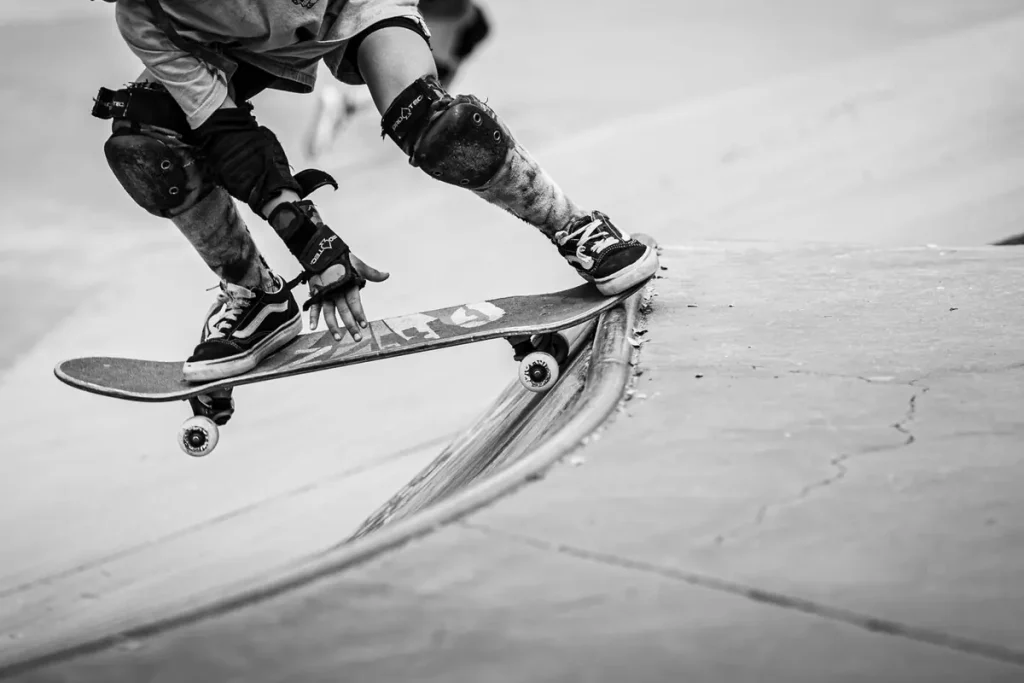
These four cover the main needs: a slim everyday pad, a thick pad for harder riding, a quick-fitting compact pad, and a full set for beginners.
🔎 How we chose these
We picked these pads by the specifications listed on Amazon and by how well they fit the job. We have not ride-tested them, and we do not show prices or star ratings because they change often. Specs were checked in October 2026, so confirm the details on the product page before you buy. LongboardHub earns from qualifying purchases as an Amazon Associate, at no extra cost to you. Read our affiliate disclosure.
🏆 Best slim everyday pad
187 Killer Pads Fly Knee Pads
Best for: Cruisers and commuters who want real protection without bulk.
A slimmer knee pad from 187 Killer Pads. The listing describes a contoured, form-fitting shape that moves naturally and keeps bulk low.
- Padding High-performance foam system
- Shape Contoured, low bulk
- Fabric Ballistic nylon
- Sizes XS to XL (10 to 20 in around the knee)
✅ Why it works
- A slim shape is comfortable for pushing and long rides.
- A seamless interior reduces rubbing.
- Ballistic nylon with heavy stitching is listed for durability.
⚠️ Keep in mind
- Slimmer pads have less padding than full-size pro pads.
- Measure around your knee and use the size chart.
Buy from Amazon Price and stock are shown on Amazon. Specs are from the Amazon listing, checked October 2026.
💪 Best for hard riding
187 Killer Pads Pro Knee Pads
Best for: Riders learning to slide or riding fast.
A thick, full-coverage knee pad. The listing says its dual-density foam is built to handle repeated hard impacts.
- Padding V-22 dual-density foam
- Cap Removable, lock-in
- Design Open back, three panels
- Sizes Junior to XL (9 to 20 in around the knee)
✅ Why it works
- Thick dual-density foam is listed for multiple hard impacts.
- The open back goes on without taking your shoes off.
- The caps can be removed and replaced.
⚠️ Keep in mind
- Thick pads are bulky and warm on long pushes.
- They cost more than slimmer pads.
Buy from Amazon Price and stock are shown on Amazon. Specs are from the Amazon listing, checked October 2026.
⚡ Easiest to put on
Triple Eight Street Knee Pads (pair)
Best for: Riders who want pads they can fit in seconds without taking off their shoes.
A compact knee pad sold as a pair. The butterfly closure opens fully, so the pads go on and off without removing your shoes.
- Padding High-density contoured EVA foam
- Cap Polyethylene, riveted
- Closure Adjustable straps, butterfly closure
- Sizes XS to L (11 to 17 in around the knee)
✅ Why it works
- The butterfly closure makes them quick to put on.
- Riveted hard caps slide on pavement.
- Sizes run from kids to adults.
⚠️ Keep in mind
- The largest size fits knees up to 17 inches around.
- Compact pads have less padding than pro-style pads.
Buy from Amazon Price and stock are shown on Amazon. Specs are from the Amazon listing, checked October 2026.
🎁 Best set for beginners
Triple Eight Saver Series Pad Set (knee, elbow, wrist)
Best for: New riders who need knees, elbows and wrists covered in one purchase.
A three-in-one set: one pair each of knee pads, elbow pads and wrist guards. It is a simple way for a new rider to get covered in one purchase.
- Includes Knee pads, elbow pads, wrist guards
- Padding EVA foam
- Caps Polycarbonate, full coverage
- Wrist guards Molded ABS splints
- Closure Elastic straps, hook and loop
✅ Why it works
- One purchase covers knees, elbows and wrists.
- A sleeveless design goes on and off easily.
- Sizes are offered for kids and adults.
⚠️ Keep in mind
- The set is sized by the wrist guards, so check the chart carefully.
- Set pads are lighter duty than separate pro pads.
Buy from Amazon Price and stock are shown on Amazon. Specs are from the Amazon listing, checked October 2026.
| Product | Type | Padding | Best for | Amazon |
|---|---|---|---|---|
| 187 Fly Knee | Slim hard cap | Foam system | Everyday riding | View on Amazon |
| 187 Pro Knee | Full-size pro | Dual-density foam | Sliding and speed | View on Amazon |
| Triple Eight Street Knee | Compact, butterfly closure | Contoured EVA foam | Quick, casual use | View on Amazon |
| Triple Eight Saver Set | Three-piece set | EVA foam | Beginners | View on Amazon |
How to wear knee pads properly
Even a good pad protects poorly if it is worn badly. These small habits make a difference.
- Centre the cap on your kneecap. With your leg slightly bent, the middle of the cap should sit over the middle of your knee.
- Fasten the lower strap first. Then the upper one. Both should be firm without digging in.
- Wear them over thin layers, not thick ones. A pad over bare skin or thin leggings stays put. A pad over loose trousers can slide with the fabric.
- Put sleeve pads on before your shoes. It sounds obvious, and everyone forgets once.
- Check them after the first few minutes. Pads settle as you warm up. Tighten the straps again if they have loosened.
Knee pads for children and smaller riders
Children and small adults need pads sized for them. An adult pad on a small knee will rotate and slip. Several makers offer junior and extra small sizes. On the listings we checked, the smallest sizes started at knee measurements of about 9 to 11 inches. Measure the child’s knee and use the chart, just as you would for an adult. For a first set, a three-piece pack with knee pads, elbow pads and wrist guards is a simple way to cover everything.
Do you need shin or hip protection too?
For cruising and commuting, no. A helmet, wrist guards and knee pads cover the most common injuries. Riders who slide or ride fast often add padded shorts to protect the hips and tailbone, and some wear pads that extend down the shin. Add those when your riding calls for them.
How to fall on knee pads
Pads work best when you use them on purpose. Experienced riders learn to fall onto their knee pads and slide, instead of putting their hands out. It is a skill worth practising.
- Practise on grass firstWearing your pads, drop gently to both knees from standing. Get used to the feeling.
- Let your knees take itAs you go down, bend your knees and let the caps touch first. Keep your hands up and off the ground.
- Lean back slightlySit back toward your heels as you slide. That keeps your weight on the caps.
- Try it at walking paceOn smooth ground, step off the board at a slow roll and drop into the slide.
- Keep your wrists out of itReaching for the ground is how wrists get broken. Wrist guards help while you unlearn the habit.
🛡️ Knee pads are one part of the picture
A helmet protects the thing you cannot repair, and it comes first. Wrist guards and elbow pads matter too, especially while you are learning. See our safety guides.
Looking after your knee pads
Pads get sweaty and take a lot of abuse. A little care keeps them comfortable and working.
- Air them out after every ride. Do not leave them zipped in a bag.
- Wash them when they need it. Follow the label. Many pads can be hand washed in cool water with mild soap, then air dried.
- Keep them out of a hot dryer. Heat damages foam and elastic.
- Close the straps before washing, so the hook-and-loop does not snag the fabric.
- Check the caps and rivets. A cracked cap or a loose rivet means the pad needs replacing.
When to replace them
Replace knee pads when the foam stays flat instead of springing back, when the cap is cracked or worn through, when the straps no longer hold, or after a very hard impact. Foam that has been crushed does not protect as well the second time.
Real-life examples: which pads would they choose?
The riders below are made-up examples, based on the kind of questions people often ask in longboarding groups and forums. They are not real people or reviews. See which one sounds most like you.
The new rider
Jamie, first board this month
Jamie has no safety gear at all and a limited budget.
Good choice: a full pad set, so knees, elbows and wrists are all covered, plus a helmet.
The daily commuter
Rosa, two miles each way
Rosa wants protection she can wear with work clothes and take off quickly.
Good choice: a compact pad with a butterfly closure, which opens flat and goes on and off without removing shoes.
The slide learner
Theo, learning to slide
Theo is practising slides on a gentle hill and keeps landing on his knees.
Good choice: a full-size pro pad with thick foam. He needs padding that can take repeated impacts.
Common mistakes (and how to fix them)
❌ Guessing the size
A loose pad slides off your kneecap exactly when you need it.
✅ The fix: Measure around your knee and use the chart for that pad.
❌ Buying pads with no hard cap for road riding
Soft pads grip the tarmac instead of sliding.
✅ The fix: Choose a hard-cap pad for riding on pavement.
❌ Wearing pads loose for comfort
Loose straps let the pad rotate in a fall.
✅ The fix: Tighten the straps until the pad stays centred when you bend your knee.
❌ Buying thick pads you never wear
Bulky pads are uncomfortable for long pushes, so they stay at home.
✅ The fix: For everyday riding, pick a slim pad you will actually use.
❌ Keeping pads long past their best
Crushed foam and cracked caps do not protect properly.
✅ The fix: Inspect them now and then, and replace them when they are worn.
Frequently asked questions
What are the best knee pads for longboarding?
The best longboard knee pads have a hard cap, dense foam and a snug fit. A slim hard-cap pad suits cruising and commuting. A thicker pro-style pad suits sliding and downhill. Well-known makers include 187 Killer Pads and Triple Eight.
Do I need knee pads for longboarding?
They are strongly recommended, especially while you are learning or riding at speed. Knees often hit the ground first in a forward fall. A helmet is the first priority, followed by wrist guards and knee pads.
How do I measure for knee pads?
Wrap a soft tape measure around the middle of your kneecap and compare the result with the size chart for the pad you are buying. Charts differ between brands, so check each one.
Should knee pads be tight or loose?
Snug. A knee pad should stay centred over your kneecap when you bend your leg and should not slide down when you kneel. It should not pinch or cut off circulation.
What is the difference between slim and pro knee pads?
Slim pads have less foam and a lower profile, so they are comfortable for long rides. Pro pads have thicker foam and larger caps for repeated hard impacts, such as when learning to slide. They are bulkier and warmer.
Your knee pad checklist
Run through this before you buy and again when the pads arrive.
- I have measured around my knee.
- I have checked the size chart for this exact pad.
- The pad has a hard cap.
- The padding suits how I ride.
- The pad stays centred when I bend my knee and kneel.
- I can put it on easily enough to wear it every ride.
- I also have a helmet and wrist guards.
The best longboard knee pads are the ones that fit you and that you wear every time. Measure first, choose a hard cap, match the padding to your riding, and your knees will thank you for years.
Still deciding?
Still choosing a board? Our free tools can help you find the right size and style.
Try the free Size Guide Take the Match Quiz Back to our picks
Product specs and availability were checked in October 2026 and can change. Always confirm the details on the product page before you buy.