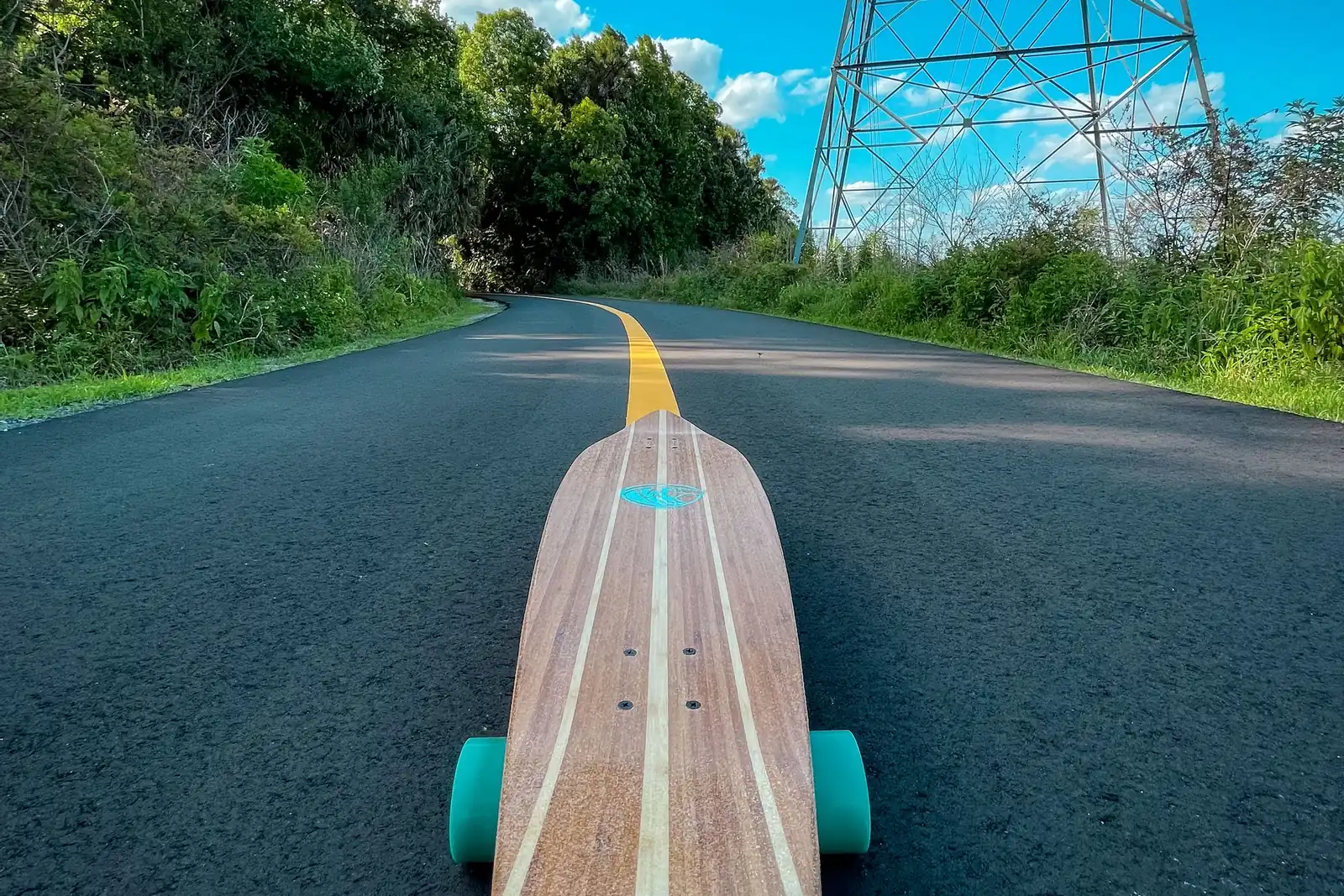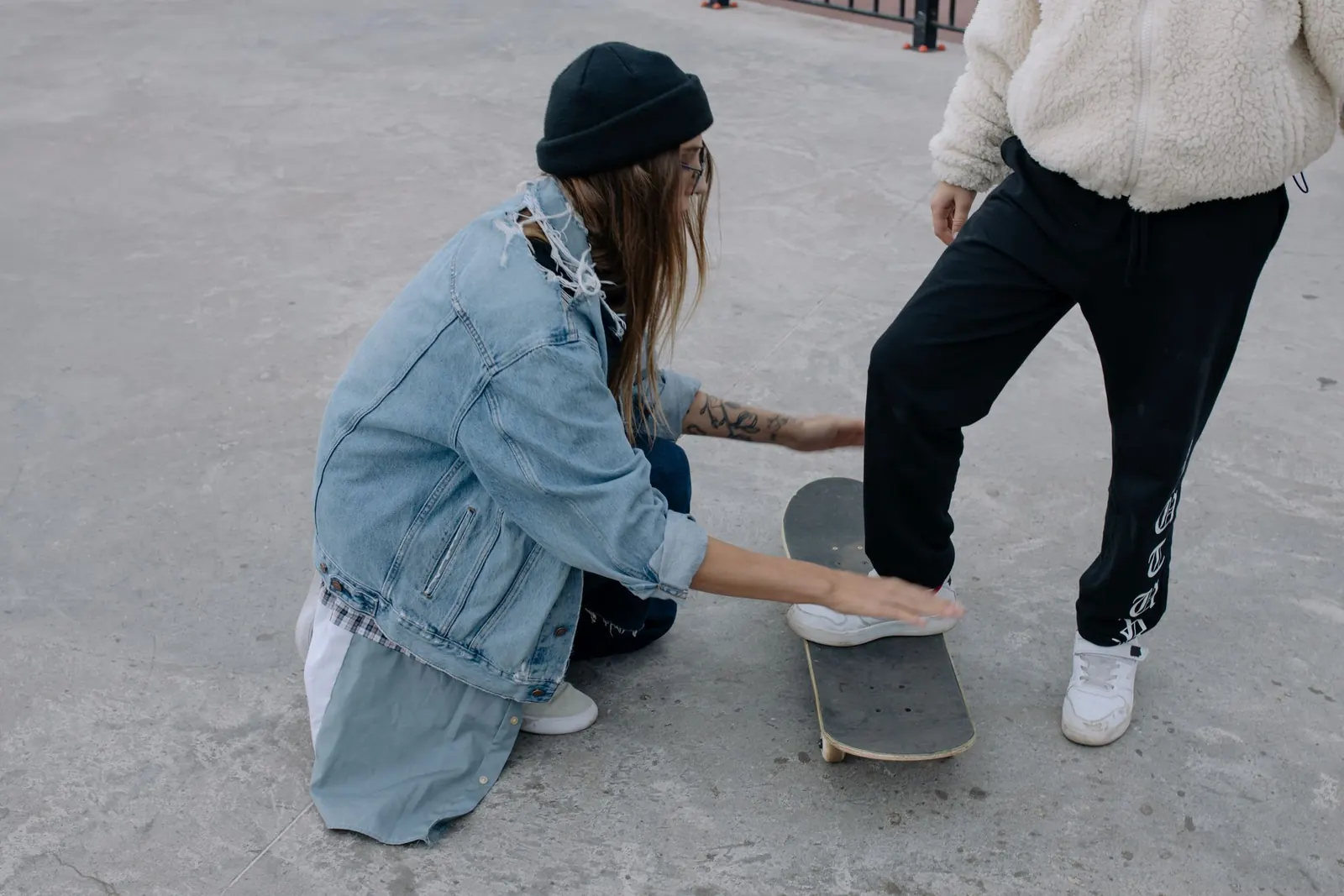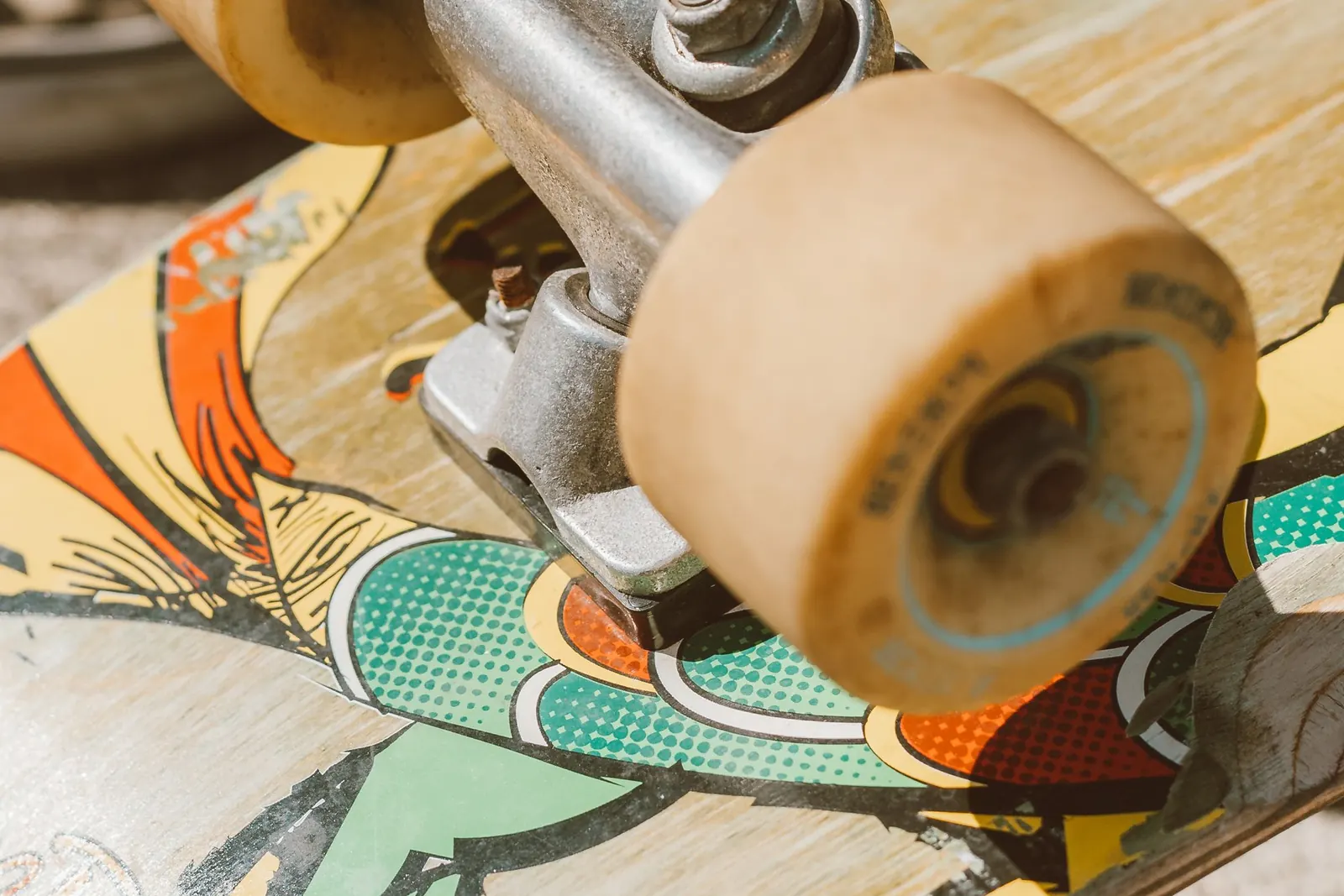
If you ask experienced riders what a beginner should buy, a lot of them say the same thing: get a drop-through. It is the most recommended first longboard for good reasons.
Here is the short answer. The best drop-through longboards are 38 to 42 inches long, with a symmetrical deck, soft wheels of about 70 mm and reverse kingpin trucks. That combination is low, stable and easy to push.
This guide explains what drop-through actually means, how it compares with other deck types, who it suits and who it does not. Then it gives you three boards to look at.
Quick answer
Lower deck, easier pushing, calmer ride
On a drop-through, the trucks mount through the deck instead of under it. That small change makes the board friendlier in almost every way.
- 📏 Length: 38–42 in
- 🛞 Wheels: about 70 mm, 78A
- 🔄 Symmetrical shape
- ⬇️ Low ride height
What is a drop-through longboard?
On a normal board, the trucks are bolted to the underside of the deck. This is called a top-mount, because the deck sits on top of the trucks.
On a drop-through, each end of the deck has a shaped hole. The base of the truck sits on top of the deck, and the rest of the truck hangs down through the hole. The deck ends up lower, roughly level with the top of the trucks instead of above them.
The difference in height is small, usually about half an inch to an inch. But you feel it on every push and in every turn.
| Effect | What you notice |
|---|---|
| Lower standing height | Your standing leg bends less when you push |
| Lower centre of gravity | The board feels steadier, especially at speed |
| Easier foot braking | Your braking foot reaches the ground sooner |
| Less leverage over the trucks | Turning is a little less sharp |
| Easier to slide | The board breaks into a slide more predictably |
Drop-through vs other deck types
Drop-through is one of four common ways to build a longboard. Here is how they compare.
| Deck type | Ride height | Turning | Best for |
|---|---|---|---|
| Top-mount | Highest | Sharpest and most responsive | Carving, and experienced riders |
| Drop-through | Lower | Smooth and predictable | Beginners, commuting, learning to slide |
| Drop deck | Low | Stable, a little slower to turn | Long pushes and relaxed speed |
| Double drop | Lowest | Very stable | Long-distance pushing |
A top-mount gives you the most control and the liveliest turning. The price is height. You stand taller, pushing takes more effort, and the board feels less forgiving.
A drop deck gets low in a different way. The deck itself is shaped so the standing area dips below the truck mounts. A double drop combines both ideas and sits lowest of all.
The drop-through is the all-rounder of the group. It is lower than a top-mount without the extra weight and cost of a shaped drop deck. That is why so many first boards are drop-throughs.
Who should buy a drop-through, and who should not?
| A good choice if… | Look elsewhere if… |
|---|---|
| You are buying your first longboard | You want the sharpest possible carving |
| You will commute or push a lot | You want to do kicktail tricks |
| You want a stable, forgiving ride | You need a very small, portable board |
| You want to learn to slide later | You want maximum grip for racing |
Beginners benefit most. A lower board is easier to balance on, easier to step off and less tiring to push. All of that helps in the first few weeks.
Commuters benefit too. Over a mile or two, the saving in effort on each push adds up.
Tricks and tight carving are the weak spots. Most drop-throughs have no kicktail, and the lower position gives you less leverage for quick, tight turns. Riders who want those things usually choose a top-mount.
What to look for in a drop-through longboard
Length
Most drop-throughs are between 36 and 42 inches. For an adult beginner, 38 to 42 is the sweet spot. Shorter boards in the 36 inch range are more agile and easier to carry. Use your height to narrow it down.
Not sure which length suits your height?
Shape and cutouts
Look at the outline. Most drop-throughs are symmetrical, which means the nose and tail are the same shape. They also narrow around the wheels. Those narrowed sections are called cutouts.
Cutouts matter. They give the wheels room to move when you lean. Without them, a wheel could touch the deck in a hard turn and stop dead. This is called wheel bite. A well-designed drop-through makes it almost impossible.
Flex
Some drop-throughs are stiff and some bend noticeably. A little flex is comfortable for cruising, because it soaks up bumps. A stiff deck is steadier at speed. Maple decks tend to be stiffer. Bamboo and composite decks tend to be springier.
Trucks and wheels
Nearly all drop-throughs use reverse kingpin trucks, about 180 mm wide. A 50-degree baseplate turns readily. A 40 to 45 degree baseplate is calmer. For wheels, around 70 mm and 78A is the classic cruising setup: big enough to roll over cracks, soft enough to grip and smooth out the road.
Weight limit
Check the listed weight limit. On the budget drop-throughs we checked, 220 lb was the most common figure, with some rated at 250 or 275 lb. The holes cut for the trucks are near the ends of the deck, so the stated limit matters.
📌 Can any truck be mounted drop-through?
Most reverse kingpin trucks can. The truck has to be taken apart so the baseplate sits on top of the deck and the hanger attaches from below. A complete board arrives with this already done.
What a drop-through feels like on your first ride
If you have only stood on a skateboard before, a drop-through will surprise you. Here is what to expect.
The first thing you notice is how close the ground is. Stepping on feels less like climbing onto something and more like stepping onto a low platform. That alone settles a lot of nerves.
The second is how gently it turns. Lean a little and the board drifts into a wide arc. It does not dart. New riders often expect a longboard to be twitchy, and a drop-through is the opposite.
The third is the push. Because your standing leg stays nearly straight, you can push several times in a row without your thigh burning. On a taller board, most beginners feel that burn within a few minutes.
There is one thing to get used to. With your feet between the trucks instead of over them, the board responds a touch later than a top-mount would. After a ride or two it feels natural, and most people stop noticing.
Three common myths about drop-throughs
- They are only for beginners. Not true. Many experienced riders choose a drop-through for commuting and for learning to slide.
- The holes make the deck weak. A properly made deck is designed around them. Stay within the listed weight limit and check for cracks now and then.
- They cannot carve. They can. They simply turn a little less sharply than a top-mount of the same size.
Our picks: 3 drop-through longboards
These three cover the budget, lightweight and premium ends of the drop-through range.
🔎 How we chose these
We picked these boards by the specifications listed on Amazon and by how well they fit the job. We have not ride-tested them, and we do not show prices or star ratings because they change often. Specs were checked in October 2026, so confirm the details on the product page before you buy. LongboardHub earns from qualifying purchases as an Amazon Associate, at no extra cost to you. Read our affiliate disclosure.
🏆 Best all-round drop-through
Shape illustration, not a product photo
Atom Drop Through Longboard (41 in)
Best for: First-time riders who want a long, low and steady board.
A 41-inch drop-through, which means the deck hangs low between the wheels. A low deck is easier to push and feels steadier under your feet. The Amazon listing marks its skill level as beginner.
- Length 41 in
- Width 9 in
- Deck Maple laminate, drop-through
- Trucks Reverse kingpin, 245 mm axles
- Wheels 70 mm, soft
- Listed weight limit 220 lb
✅ Why it works
- The low drop-through deck takes effort out of every push.
- A 41-inch length gives a long, calm wheelbase.
- The deck is cut away around the wheels, which the maker says removes wheel bite.
- It is listed as arriving fully assembled.
⚠️ Keep in mind
- The 9-inch deck is on the narrow side for big feet (about US men’s 12 and up).
- The listed weight limit is 220 lb.
- At 41 inches it is not the easiest board to carry on a crowded bus.
Buy from Amazon Price and stock are shown on Amazon. Specs are from the Amazon listing, checked October 2026.
🎒 Best light drop-through
Shape illustration, not a product photo
Volador Urban Freeride Pro Longboard (40 in)
Best for: Riders who will carry their board often.
A light 40-inch drop-through with a shallow concave deck. The listing describes it as made for urban and campus commutes and casual cruising.
- Length 40 in
- Width 9 in
- Deck 8-layer maple with epoxy resin, drop-through
- Trucks Forged reverse kingpin
- Wheels 70 mm, 78A
- Bearings ABEC-9
- Listed weight limit 220 lb
✅ Why it works
- At a listed 6.2 lb it is light for a 40-inch board.
- The drop-through deck is low and easy to push.
- Soft 78A wheels absorb vibration, according to the listing.
⚠️ Keep in mind
- The listed weight limit is 220 lb.
- The 9-inch deck is narrow for very big feet.
- It is sold in several graphics. Our link opens one of them.
Buy from Amazon Price and stock are shown on Amazon. Specs are from the Amazon listing, checked October 2026.
💎 Best premium drop-through
Shape illustration, not a product photo
Arbor Flagship Axis Complete (40 in)
Best for: Riders who want named trucks and a real wood finish.
Arbor describes the Axis as a snowboard-inspired drop-through for easy cruising around town, relaxed commutes and mellow downhill. The deck is 8-ply maple with a palisander wood top and bottom.
- Length 40 in
- Width 9 in
- Deck 8-ply Canadian maple with palisander, drop-through
- Trucks Paris 180 mm, 50°
- Wheels Arbor Outlook 69 mm, 78A
✅ Why it works
- Drop-through mounting keeps it low and easy to push.
- Paris 180 mm trucks are fitted.
- Soft 69 mm, 78A wheels are described as grippy.
- Arbor says the wood comes from sustainable sources.
⚠️ Keep in mind
- The listing does not give a weight limit.
- A 9-inch deck is narrow for very big feet.
- Stock was low when we checked, so availability may vary.
Buy from Amazon Price and stock are shown on Amazon. Specs are from the Amazon listing, checked October 2026.
| Product | Length | Wheels | Trucks | Amazon |
|---|---|---|---|---|
| Atom Drop Through 41 | 41 in | 70 mm, soft | Reverse kingpin, 245 mm axles | View on Amazon |
| Volador Freeride 40 | 40 in | 70 mm, 78A | Forged reverse kingpin | View on Amazon |
| Arbor Axis 40 | 40 in | 69 mm, 78A | Paris 180 mm, 50° | View on Amazon |
Which one should you choose?
- You want the classic first board: the Atom Drop Through 41.
- You carry your board a lot: the Volador, at a listed 6.2 lb.
- You want better parts and finish: the Arbor Axis.
How to choose your drop-through in 5 steps
- Pick a length for your heightMost adults suit 38 to 42 inches. Go shorter if you are smaller or need to carry it.
- Check the width against your shoesAbout 9 inches suits most feet. Big feet are happier at 9.5 to 10.
- Decide on flexChoose stiffer for speed and heavier riders. Choose springier for relaxed cruising.
- Check the wheelsLook for about 70 mm and 78A unless you have a reason to choose otherwise.
- Check the weight limitMake sure it sits comfortably above your weight, bag included.
Setting up and looking after a drop-through
A drop-through needs very little attention, but two things are specific to this design.
- Check the mounting bolts. The bolts pass through the thin section of deck around the hole. Keep them snug, and check them every few weeks.
- Watch for cracks near the holes. The cut-out area is the most stressed part of the deck. A small crack there is a reason to stop riding and replace the deck.
- Tune the trucks. If the board feels unwilling to turn, loosen the large nut on each truck a quarter turn. If it feels wobbly, tighten it a quarter turn.
- Keep it dry. Water damages bearings and wooden decks. Dry the board after a wet ride.
🛡️ Wear a helmet every ride
A helmet is the one piece of gear that is not optional. Wrist guards, knee pads and elbow pads are well worth it while you learn. See our safety guides.
Real-life examples: is a drop-through right for them?
The riders below are made-up examples, based on the kind of questions people often ask in longboarding groups and forums. They are not real people or reviews. See which one sounds most like you.
The nervous beginner
Chloe, 5′4″, 125 lb
Chloe has never skated and worries about falling.
Good choice: a drop-through of about 38 to 40 inches. The low deck is easier to balance on and easy to step off.
The campus commuter
Ethan, 5′11″, 175 lb
Ethan wants to cover a mile and a half between his flat and campus.
Good choice: a 40 to 41 inch drop-through with 70 mm soft wheels. It is the classic board for exactly this trip.
The trickster
Ruby, 5′6″, 135 lb
Ruby wants to learn manuals and shove-its.
Good choice: a top-mount board with kicktails instead. A drop-through is the wrong tool for tricks.
Common mistakes (and how to fix them)
❌ Expecting sharp, surfy turns
A drop-through trades some turning for stability.
✅ The fix: Loosen the trucks a little, or choose a top-mount if carving is your priority.
❌ Ignoring the weight limit
Many budget drop-throughs are rated to 220 lb.
✅ The fix: Pick one rated higher if you are close to that.
❌ Choosing too short a board
A 36-inch drop-through is noticeably livelier than a 40.
✅ The fix: Stay at 38 to 42 inches for a first board unless you are small.
❌ Never checking the bolts
Vibration loosens them over time.
✅ The fix: Give them a quick check every few weeks.
❌ Riding with hard wheels
Hard wheels undo the comfort a drop-through gives you.
✅ The fix: Use soft wheels of about 78A.
Key terms in plain English
Longboard listings use a lot of jargon. Here are the terms used in this guide, explained simply.
| Term | What it means |
|---|---|
| Drop-through | A deck with holes that the trucks mount through, so the deck sits lower. |
| Top-mount | A deck that sits on top of the trucks. It rides higher and turns more sharply. |
| Drop deck | A deck shaped so the standing area dips below the truck mounts. Also called drop-down. |
| Reverse kingpin (RKP) | The usual truck design on longboards. The main bolt faces outward, which makes the truck turn smoothly and stay stable. |
| Baseplate angle | The angle of the part of the truck that bolts to the deck. About 50 degrees turns easily. About 40 to 45 degrees is calmer at speed. |
| Cutouts | Sections of deck removed around the wheels, giving them room to move when you lean. |
| Wheel bite | When a wheel touches the deck in a hard turn and stops suddenly. Cutouts, wheel wells and risers prevent it. |
| Flex | How much the deck bends under your weight. Some flex is comfortable. Stiff is steadier at speed. |
| Durometer | Wheel hardness, shown as a number and the letter A. Around 78A is soft and grippy. The mid 80s and above are firmer. |
| Foot brake | Slowing down by lowering your back foot and dragging the sole lightly on the ground. |
| Sliding | Turning the board sideways so the wheels skid, to slow down or stop. An advanced skill that needs gloves and pads. |
| Wheelbase | The distance between the front and back trucks. Longer feels steadier. Shorter turns tighter. |
Frequently asked questions
What is the best drop-through longboard?
The best drop-through longboards are 38 to 42 inches long with a symmetrical cut-out deck, soft wheels of about 70 mm and reverse kingpin trucks. That combination is low, stable and easy to push, which suits beginners and commuters.
Are drop-through longboards good for beginners?
Yes. The lower deck makes balancing, pushing and foot braking easier, and the board feels steadier. Drop-throughs are one of the most commonly recommended first longboards.
What is the difference between drop-through and top-mount?
On a top-mount, the deck sits on top of the trucks. On a drop-through, the trucks are mounted through holes in the deck, which lowers it. Drop-throughs are more stable and easier to push. Top-mounts turn more sharply.
Is a drop-through good for carving?
It can carve, but less sharply than a top-mount, because you have less leverage over the trucks. Drop-throughs with large cutouts and a flexible deck carve best.
What size drop-through longboard should I get?
Most adults suit 38 to 42 inches. Smaller riders, or those who need to carry the board often, can go down to about 36 inches.
Your drop-through checklist
A board that ticks these boxes will be a good drop-through for you.
- It is 38 to 42 inches long, or shorter if I am small.
- The width suits my shoe size.
- The deck has cutouts around the wheels.
- The wheels are about 70 mm and soft.
- The trucks are reverse kingpin.
- The listed weight limit is comfortably above my weight.
- I have a helmet.
A drop-through is popular because it is easy to live with. It is low, calm and forgiving. Pick the right length, check the weight limit, and you will have a board that makes learning and commuting simpler.
Still deciding?
Get a size worked out for you, or jump back to the picks.
Try the free Size Guide Take the Match Quiz Back to our picks
Product specs and availability were checked in October 2026 and can change. Always confirm the details on the product page before you buy.