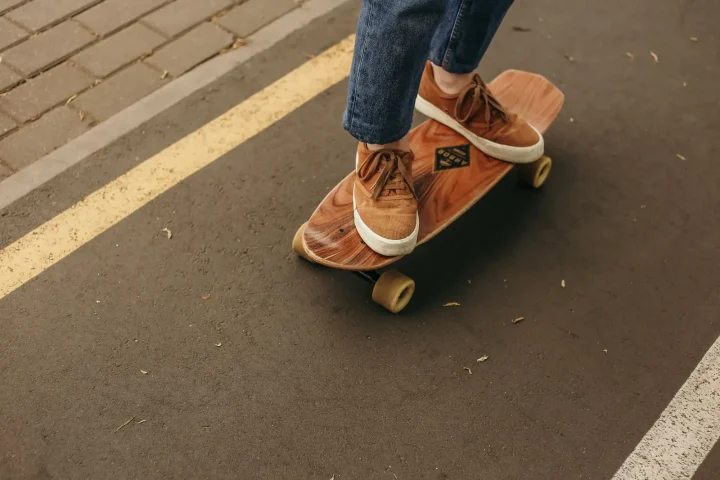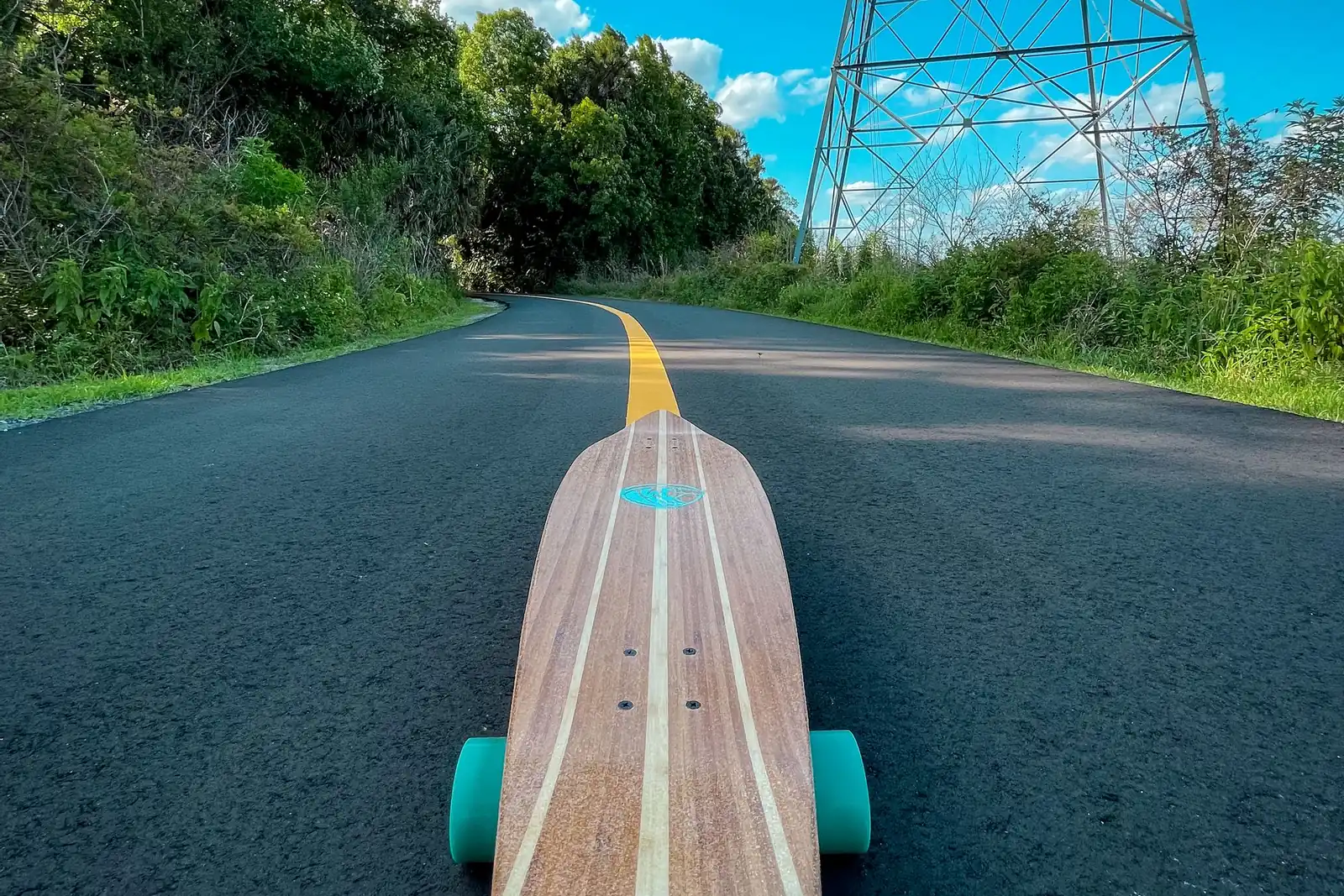
A longboard can be a brilliant way to get around a city. No parking, no timetable, and a mile takes a few minutes. But city riding is demanding. Rough pavement, kerbs, crowds and stairs all ask something of your board.
Here is the short answer. The best longboard for city transportation has a low deck that is easy to push, soft wheels of 70 mm or more, and a size you can carry. For most people that means a drop-through board of about 36 to 41 inches.
This guide helps you match a board to your actual commute. It covers distance, road surface, public transport and storage, and gives you three boards to look at.
Quick answer
Low to push, soft wheels, easy to carry
Your commute decides the size. Short hops with a bus or train want a small board. Longer rides want a longer, lower one.
- 📏 Length: 36–41 in
- 🛞 Wheels: 70 mm+, 78A
- ⬇️ Drop-through deck
- 🎒 Light enough to carry
What makes a longboard good for city transportation?
A commuter board has a different job from a weekend cruiser. It has to work every day, on roads you did not choose, and it has to come indoors with you. Five things matter most.
- Easy pushing. You will push hundreds of times per trip. A low deck makes each push easier.
- A smooth roll. City pavement is cracked and patchy. Soft, larger wheels cope far better than small, hard ones.
- Sure stopping. You must be able to foot brake quickly at junctions and crossings.
- Easy carrying. Stairs, shops, offices and buses all mean picking the board up.
- Quick handling. You need to steer around people, drains and potholes without drama.
| Feature | Look for | Why it matters |
|---|---|---|
| Deck type | Drop-through or drop deck | Lower deck, easier pushing and braking |
| Length | 36–41 in (shorter with public transport) | Stable but still easy to carry |
| Wheels | 70 mm or more, about 78A | Rolls over cracks and soaks up vibration |
| Weight | As light as you can find | You will carry it every day |
| Kicktail | Useful, not essential | Helps with kerbs and tight turns |
| Weight limit | Above your weight plus your bag | A loaded backpack counts |

Match the board to your commute
There is no single best city board, because commutes differ so much. Find your situation in this table.
| Your commute | Board to look for | Why |
|---|---|---|
| Under a mile, plus a bus or train | Mini cruiser, 27–32 in | Small enough to hold on your lap or stand between your feet |
| One to three miles, mostly riding | Drop-through, 36–41 in | Easy to push and stable, still manageable to carry |
| Over three miles | Drop deck or a low board with bigger wheels | Saves your legs over distance |
| Very rough roads | Any low board with 75 mm or larger soft wheels | Wheel size matters more than anything else here |
| Lots of kerbs and crowds | A shorter board with a kicktail | Quick pivots and easy kerb hops |
Most city riders land on the second row. A drop-through of about 40 inches is the classic commuter for good reasons. It is low, it is calm, and it fits under most desks.
Hills change the picture as well. A longboard has no gears and no hand brake. Short, gentle slopes are fine once you can foot brake well. A long or steep hill on your route is a reason to walk that stretch, or to pick a different route.
If your trip includes public transport, be realistic about size. A 41-inch board on a packed train at rush hour is not fun for you or for anyone near you. A mini cruiser gives up some stability, but it fits into the rest of your day.
The features that matter, explained
A low deck
On a drop-through board, the trucks are mounted through the deck instead of underneath it. That drops the standing platform by an inch or so. It sounds small, but your standing leg bends less on every push, and your braking foot reaches the ground more easily. Over a daily commute, that is a lot of saved effort.
Wheels for real streets
Wheel hardness is given as a number with the letter A. Around 78A is soft and grippy. Soft wheels flatten slightly over rough ground and absorb vibration. Size matters too. A 70 mm wheel rolls over cracks that would stop a 55 mm skateboard wheel dead. On bad roads, go bigger still if the board has room.
Portability
Weigh up three things: length, weight and shape. A shorter board tucks under an arm. A lighter board is no trouble on stairs. Cutouts and handles help too. Some decks have a hand hole or a shaped waist that makes them easier to grip.
A kicktail
A kicktail is an upturned tail. Step on it and the nose lifts. That lets you pivot sharply around an obstacle or pop the front wheels up a kerb. It is not essential, since you can simply step off, but it makes busy pavements easier.
Stopping
The city has no shortage of surprises, so stopping matters more than speed. The basic stop is the foot brake: you lower your back foot and drag the sole lightly on the ground. Practise it until it is automatic. Wear shoes with flat, sturdy soles, because braking wears them down.
⚠️ Avoid riding in the rain
Wet pavement is slippery, painted lines and metal covers are worse, and water gets into bearings and makes them rust. If you get caught out, slow right down and dry your board afterwards.
Longboard vs bike vs scooter for getting around
Is a longboard actually the right tool for your trip? It helps to compare it honestly with the other small ways of getting around.
| Factor | Longboard | Bicycle | Kick scooter |
|---|---|---|---|
| Carrying it indoors | Easy | Hard | Easy |
| Parking and theft worries | None, it comes with you | A real concern | None, it comes with you |
| Comfortable range | About 1 to 3 miles | Many miles | About 1 to 2 miles |
| Rough roads | Fair, with big soft wheels | Good | Poor, with small wheels |
| Braking | Foot brake, takes practice | Strong hand brakes | Simple rear brake |
| Learning time | A few weeks | Most people already ride | Minutes |
A longboard wins on convenience. It needs no lock and no parking space, and it fits under a desk. It suits short trips on reasonable pavement, and trips that link up with a bus or a train.
A bike is better for longer distances, steep hills and wet weather. A kick scooter is quicker to learn. If your commute is five miles of rough road in the rain, a longboard is the wrong tool, and it is better to know that before you buy.
What to wear and carry
- Flat, sturdy shoes. Foot braking wears soles down, so avoid your best pair.
- A backpack worn on both shoulders. A bag hanging off one shoulder pulls you off balance.
- A skate tool. It weighs almost nothing and fixes most roadside problems.
- Lights or reflective strips for early mornings and evenings.
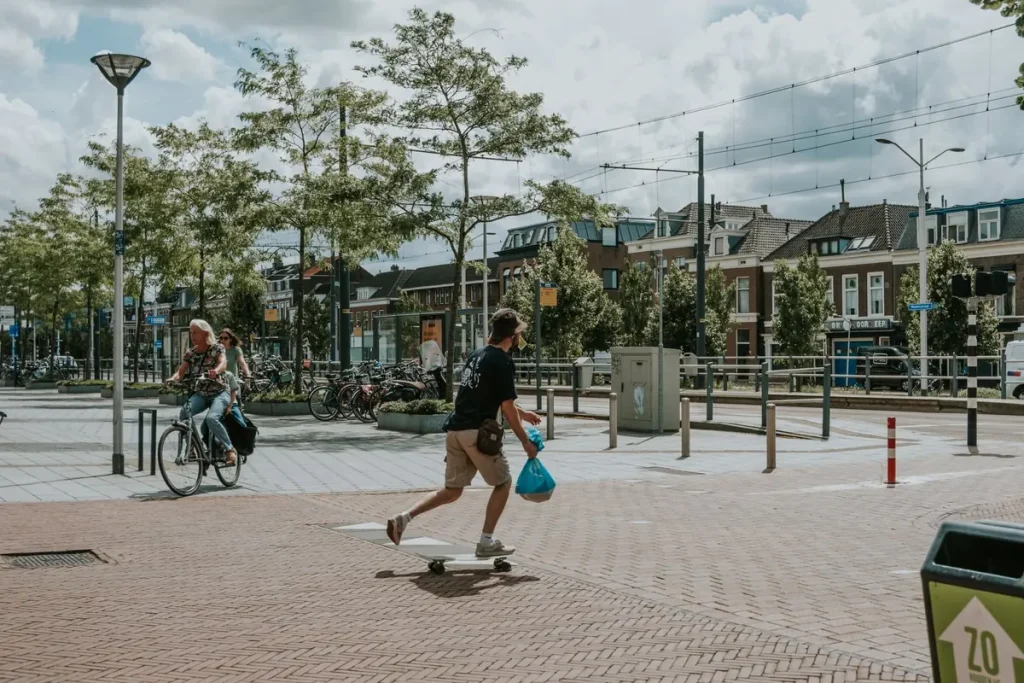
Our picks: 3 longboards for city transportation
These three suit three kinds of commute: a steady rider, a board carrier and a mixed public transport trip.
🔎 How we chose these
We picked these boards by the specifications listed on Amazon and by how well they fit the job. We have not ride-tested them, and we do not show prices or star ratings because they change often. Specs were checked in October 2026, so confirm the details on the product page before you buy. LongboardHub earns from qualifying purchases as an Amazon Associate, at no extra cost to you. Read our affiliate disclosure.
🏆 Best all-round commuter
Shape illustration, not a product photo
Atom Drop Through Longboard (40 in)
Best for: Riders with a one to three mile commute who want a calm, low board.
A 40-inch drop-through with a maple and bamboo hybrid deck, according to the listing’s bullet points. Its trucks use a 40-degree base, which turns a little less sharply than the usual 50 degrees and feels calmer as speed builds.
- Length 40 in
- Width 9 in
- Deck Maple and bamboo hybrid laminate, drop-through
- Trucks 180 mm hangers, 40° base
- Wheels 70 x 51 mm, 78A
- Bearings ABEC 9
- Listed weight limit 220 lb
✅ Why it works
- The low deck is easy to push and steady underfoot.
- Soft 78A wheels and coarse 46-grit grip tape are listed.
- The 40-degree baseplates lean toward stability.
- The listing marks its skill level as beginner.
⚠️ Keep in mind
- The details table says maple, while the bullet points say maple and bamboo hybrid.
- The listed weight limit is 220 lb.
- The 9-inch deck is narrow for very big feet.
Buy from Amazon Price and stock are shown on Amazon. Specs are from the Amazon listing, checked October 2026.
🎒 Best light commuter
Shape illustration, not a product photo
Volador Urban Freeride Pro Longboard (40 in)
Best for: Riders who carry their board up stairs or into buildings every day.
A light 40-inch drop-through with a shallow concave deck. The listing describes it as made for urban and campus commutes and casual cruising.
- Length 40 in
- Width 9 in
- Deck 8-layer maple with epoxy resin, drop-through
- Trucks Forged reverse kingpin
- Wheels 70 mm, 78A
- Bearings ABEC-9
- Listed weight limit 220 lb
✅ Why it works
- At a listed 6.2 lb it is light for a 40-inch board.
- The drop-through deck is low and easy to push.
- Soft 78A wheels absorb vibration, according to the listing.
⚠️ Keep in mind
- The listed weight limit is 220 lb.
- The 9-inch deck is narrow for very big feet.
- It is sold in several graphics. Our link opens one of them.
Buy from Amazon Price and stock are shown on Amazon. Specs are from the Amazon listing, checked October 2026.
🚌 Best with public transport
Landyachtz Dinghy Complete (28.5 in)
Best for: Riders whose trip includes a bus, train or tight storage.
The Dinghy is Landyachtz’s well-known mini cruiser. At 28.5 inches it is built to be carried, with soft 63 mm wheels for city pavement.
- Length 28.5 in
- Width 8 in
- Deck 7 ply
- Trucks Aluminum
- Wheels 63 mm, 78a
✅ Why it works
- At 28.5 inches and a listed 6 lb it is easy to carry.
- Soft 63 mm, 78a wheels suit city streets.
- The listing says it suits teens and adults at all skill levels.
⚠️ Keep in mind
- The listing gives few details.
- A short board is livelier and less forgiving than a full-size longboard.
- Stock was low when we checked, so availability may vary.
Buy from Amazon Price and stock are shown on Amazon. Specs are from the Amazon listing, checked October 2026.
| Product | Length | Wheels | Best for | Amazon |
|---|---|---|---|---|
| Atom Drop Through 40 | 40 in | 70 mm, 78A | Steady riding commutes | View on Amazon |
| Volador Freeride 40 | 40 in | 70 mm, 78A | Carrying every day | View on Amazon |
| Landyachtz Dinghy | 28.5 in | 63 mm, 78a | Mixed transport trips | View on Amazon |
Which one should you choose?
- You mostly ride: the Atom Drop Through 40, whose 40-degree trucks lean toward stability.
- You carry it a lot: the Volador, at a listed 6.2 lb.
- You take a bus or train: the Landyachtz Dinghy, which is small enough to keep with you.
Want a length matched to your height?
How to choose your commuter board in 5 steps
- Measure your routeHow far is it, and how much of it is riding? Use a map app to check the distance.
- Look at the surfaceSmooth cycle paths suit any wheel. Cracked pavements call for 70 mm or more.
- Decide how you will carry and store itWhere does the board go at work, at school or on the train? That sets your maximum length.
- Pick the deck typeChoose a drop-through for most commutes. Choose a mini cruiser if portability comes first.
- Check the weight limitAdd the weight of your bag to your own weight, and make sure the listed limit covers both.
Steps one to three are about your day, not about boards. That is the right way round. The best commuter is the one that fits your routine without a fight.
Should you buy a complete or build your own?
For a first commuter, buy a complete. A complete board arrives assembled, with trucks, wheels and bearings that were chosen to work together. It costs less than buying the parts one by one, and you can ride it the day it arrives.
Building your own makes sense later. Once you know what you like, you can choose a deck, trucks and wheels to suit your exact route. Many riders keep their first complete and simply upgrade the wheels, which is the cheapest change with the biggest effect on a rough commute.
Riding in the city: practical tips
- Plan a quiet routeThe shortest route is not always the best. Cycle paths and quiet streets are safer and smoother than main roads.
- Know the local rulesRules on where you can ride differ from place to place. Check what applies to pavements, cycle lanes and roads where you live.
- Be visibleUse lights and something reflective at dusk and at night. Drivers are not expecting a longboard.
- Carry a skate toolA loose truck or wheel nut takes a minute to fix if you have the tool with you.
- Keep your bearings dryAfter a damp ride, wipe the board down and spin the wheels dry. Clean the bearings if they start to sound gritty.
- Watch for tracks and drainsTram tracks, grates and wide cracks can catch a wheel. Cross them at an angle, or step off.
🛡️ Wear a helmet every ride
A helmet is the one piece of gear that is not optional. Wrist guards, knee pads and elbow pads are well worth it while you learn. City riding means cars, doors and pedestrians, so it matters even on short trips. See our safety guides.
Real-life examples: which board would they choose?
The riders below are made-up examples, based on the kind of questions people often ask in longboarding groups and forums. They are not real people or reviews. See which one sounds most like you.
The two-mile commuter
Hannah, 5′6″, 140 lb
Hannah rides two miles to her office on cycle lanes and keeps her board under her desk.
Good choice: a drop-through of about 38 to 40 inches with 70 mm soft wheels. It is low, stable and fits under a desk.
The train rider
Omar, 5′10″, 170 lb
Omar rides half a mile to the station, takes a crowded train, then rides another half mile.
Good choice: a mini cruiser of about 28 to 32 inches. It gives up some stability, but it is the only size that works on the train.
The rough-road rider
Grace, 5′8″, 190 lb
Grace has three miles of cracked, patched streets between home and college.
Good choice: a low board with soft wheels of 75 mm or more, and a weight limit that covers her and her backpack.
Common mistakes (and how to fix them)
❌ Buying a board too big to carry
A 44-inch board is lovely to ride and a nuisance everywhere else.
✅ The fix: Decide where the board will live during the day before you choose a length.
❌ Using hard skateboard wheels
Small, hard wheels stop at every crack and rattle your feet.
✅ The fix: Use soft wheels of 70 mm or more.
❌ Not practising the foot brake
A commute is full of sudden stops.
✅ The fix: Practise braking on a quiet street until it is second nature.
❌ Forgetting the backpack
A heavy bag raises your centre of gravity and adds to the load on the deck.
✅ The fix: Check the weight limit with your bag included, and keep the bag snug on both shoulders.
❌ Riding the fastest route
Main roads are quick and stressful.
✅ The fix: Try a quieter route. It is often nearly as fast and much more pleasant.
Frequently asked questions
What is the best longboard for city transportation?
For most commutes, a drop-through longboard of about 36 to 41 inches with soft wheels of 70 mm or more is the best choice. It is low and easy to push, stable on rough pavement and still manageable to carry.
Is a longboard good for commuting?
Yes, for short to medium trips. A longboard is quick over one to three miles, needs no parking and is easy to combine with public transport. It works best on dry days and reasonable road surfaces.
What size longboard is best for commuting?
About 36 to 41 inches suits most riding commutes. If your trip includes a bus or train, a mini cruiser of 27 to 32 inches is much easier to carry and store.
Are bigger wheels better for city riding?
Usually, yes. Wheels of 70 mm or more roll over cracks and rough patches that catch smaller wheels. On very rough roads, 75 mm or larger is better if the board has clearance for them.
Can you ride a longboard in the rain?
It is best avoided. Wet pavement, painted lines and metal covers are slippery, and water causes bearings to rust. If you are caught in the rain, slow down and dry the board afterwards.
Your city commuter checklist
Tick these off and your board will suit your commute.
- I know my route distance and surface.
- I know where the board will be stored during the day.
- The deck is low: a drop-through or a drop deck.
- The wheels are soft and 70 mm or more.
- I can carry the board comfortably.
- The weight limit covers me and my bag.
- I can foot brake confidently.
- I have a helmet, and lights for dusk.
The best longboard for city transportation is the one that fits your route and your routine. Keep it low, keep the wheels soft, keep it carryable, and your commute might become the best part of your day.
Still deciding?
Get a size worked out for you, or jump back to the picks.
Try the free Size Guide Take the Match Quiz Back to our picks
Product specs and availability were checked in October 2026 and can change. Always confirm the details on the product page before you buy.