Trucks are the part of a longboard that people think about least and feel the most. They decide how your board turns, how stable it is at speed and how it responds when you lean.
Here is the short answer. The best longboard trucks for most riders are reverse kingpin trucks, about 180 mm wide, with a 50-degree baseplate. That is the standard cruising and carving setup, and it fits most longboard decks of 9 to 10 inches.
Your deck and your riding style can change that answer. This guide explains truck width, baseplate angle and bushings in plain English, shows you how to match trucks to a deck, and suggests three sets to look at.
Quick answer
Reverse kingpin, about 180 mm, 50° baseplate
That setup suits most cruising and carving. Go narrower for narrow decks and lower in angle for speed.
- 📏 Width to match your deck
- 📐 50° to carve, 44° for speed
- 🎱 Bushings to match your weight
- 🔩 Sold in pairs
What do longboard trucks do?
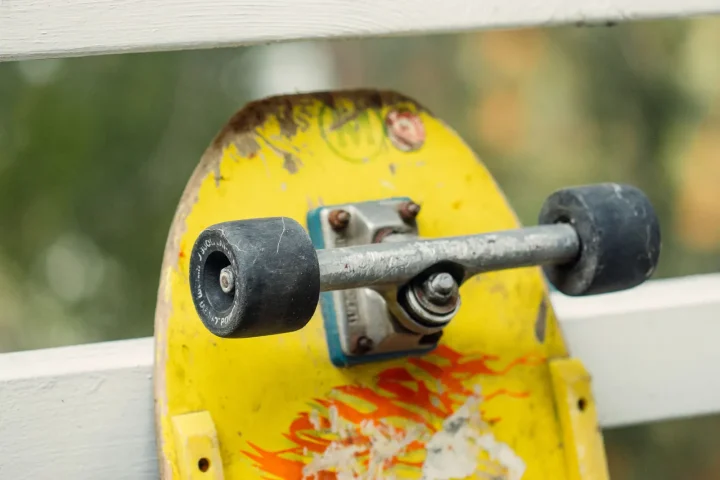
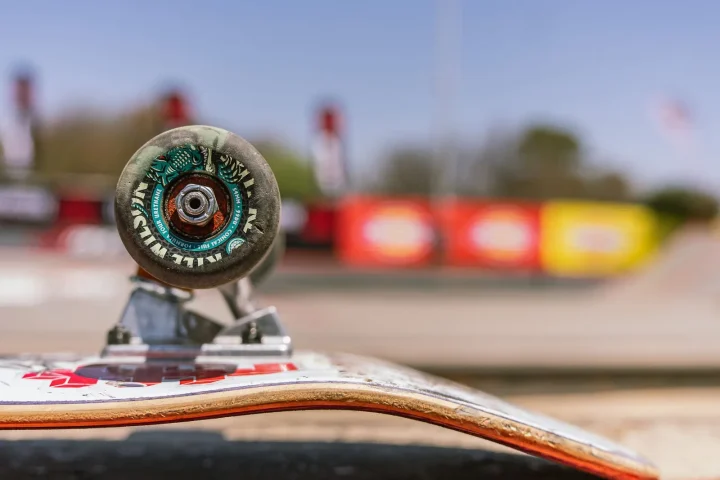
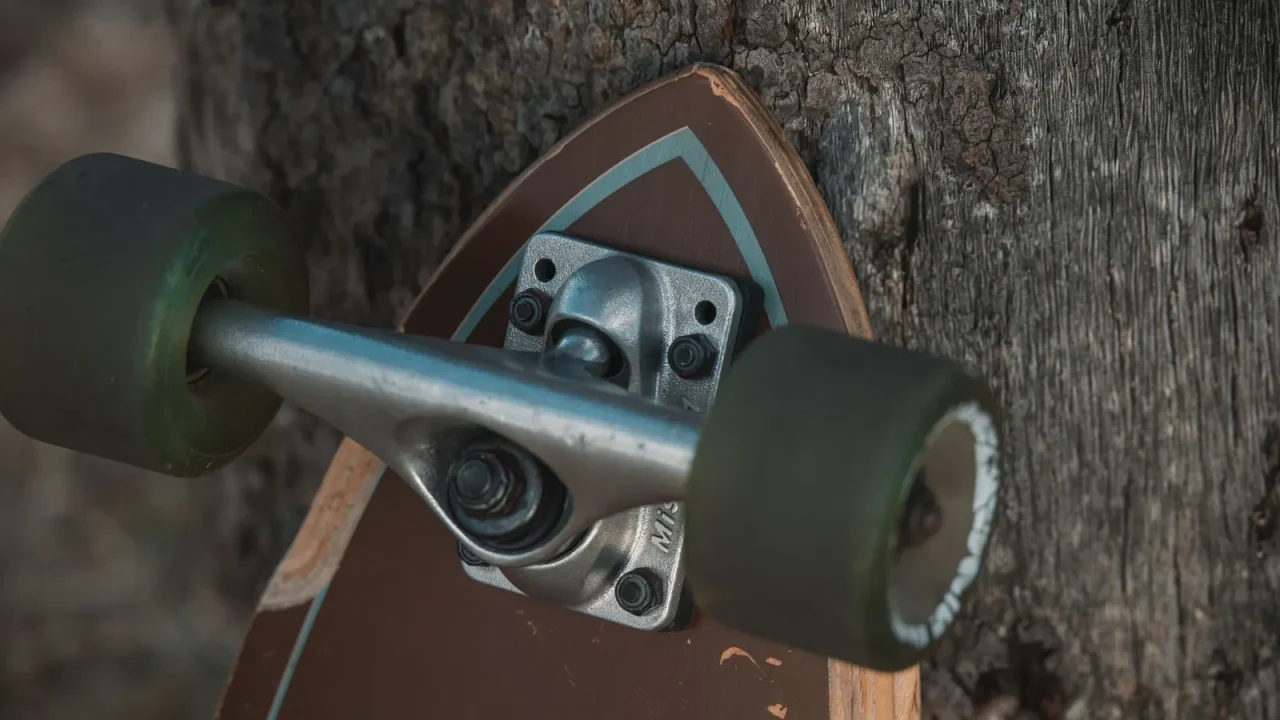
A truck is the metal assembly that bolts to the underside of your deck and holds two wheels. Every board has two. Their job is to turn your lean into a turn.
When you press on one edge of the deck, the truck pivots and the axle swings. One wheel moves forward and the other back, and the board curves in that direction. How much it curves for a given lean depends on the design of the truck.
| Part | What it is | What it affects |
|---|---|---|
| Baseplate | The plate that bolts to the deck | The turning angle |
| Hanger | The T-shaped piece that carries the axle | Width and stability |
| Axle | The rod the wheels spin on | Where the wheels sit |
| Kingpin | The large bolt holding the truck together | Tightness |
| Bushings | Two rubbery rings around the kingpin | How easily the truck leans |
| Pivot cup | A small cup where the hanger meets the baseplate | Smoothness |
Reverse kingpin vs traditional kingpin
There are two families of truck. The difference is which way the kingpin points.
| Type | How it rides | Found on |
|---|---|---|
| Reverse kingpin (RKP) | Smooth, deep turning and stable at speed | Most longboards |
| Traditional kingpin (TKP) | Quick, snappy turning and lower height | Skateboards and many mini cruisers |
On a reverse kingpin truck, the kingpin faces outward, toward the end of the board. The geometry gives a smooth, progressive lean and good stability. This is the standard longboard truck.
On a traditional kingpin truck, the kingpin faces inward. These trucks sit lower and respond quickly at low speed, which is why they are used on skateboards and on small cruisers.
If you are buying trucks for a longboard of 36 inches or more, you almost certainly want reverse kingpin.
How to match trucks to your deck
Width is the first thing to get right. Trucks that are too narrow leave the deck overhanging the wheels. Trucks that are too wide stick out past the deck, where your pushing foot can catch them.
Truck width is usually given as the width of the hanger, in millimetres. The axle is longer than the hanger, and the wheels sit on its ends. As a guide:
| Deck width | Hanger width to look for | Typical use |
|---|---|---|
| 8 to 8.75 in | About 150 mm | Narrow cruisers and small boards |
| 9 to 10 in | About 180 mm | Most longboards |
| Over 10 in | 180 mm or wider | Very wide decks |
The aim is for the outside edge of each wheel to sit roughly in line with the edge of the deck, or just inside it. Remember that wheel width matters too. Wide wheels on wide trucks can stick out further than you expect.
Mounting holes
Truck baseplates have either four or six bolt holes. The six-hole version fits both of the hole spacings that decks use, known as old school and new school. Most modern longboard trucks have six holes and fit almost any deck.
Drop-through decks
On a drop-through deck, the baseplate sits on top of the deck and the hanger hangs below. Most reverse kingpin trucks can be mounted this way, because the hanger can be removed from the baseplate. Check the listing if you plan a drop-through build.
Baseplate angle: 50 degrees or lower?
The baseplate angle is the second big choice. It decides how much the truck turns for a given lean.
| Angle | How it feels | Best for |
|---|---|---|
| About 50° | Turns readily, lively | Cruising, carving, commuting |
| About 44° to 45° | More lean, less turn, calmer | Freeride and faster riding |
| About 40° and lower | Very stable, slow to turn | Downhill |
At 50 degrees, a small lean produces a good amount of turn. That is ideal at normal riding speeds and is what most complete longboards come with.
At 44 degrees or so, you have to lean further to get the same turn. The board feels calmer, which is what you want as speed builds. Lower-angle baseplates also sit slightly lower to the ground.
Some riders mix the two, with a higher angle at the front and a lower one at the back. The front steers and the back follows. It is a common setup for fast riding, and not something a beginner needs.
Bushings: the cheapest way to change how your trucks feel
Bushings are the two rubbery rings on the kingpin. They are the cheapest part of a truck and the one that changes the ride the most.
Soft bushings let the truck lean with little effort. Hard bushings resist. The right hardness depends mainly on your weight, because a heavier rider squashes a bushing more easily.
| Rider weight | Bushing hardness to try |
|---|---|
| Under 120 lb | Soft, about 80a to 87a |
| 120 to 160 lb | Soft to medium, about 85a to 88a |
| 160 to 200 lb | Medium, about 88a to 90a |
| 200 to 240 lb | Medium-hard, about 90a to 93a |
| Over 240 lb | Hard, about 93a to 96a |
Treat that as a starting point. Go a step softer if you want easy, deep carving. Go a step harder if you want stability at speed.
Bushing shape matters as well. A cone-shaped bushing has less material and turns easily. A barrel-shaped one has more and feels steadier. Many trucks use a barrel on the deck side and a cone on the road side as a middle ground.
💡 Before you buy new trucks
If your board does not turn the way you want, try new bushings first. A set costs very little, and it often fixes the problem that made you think you needed new trucks.
Cast, forged and precision trucks
You will see these three words in truck descriptions. They describe how the metal is shaped.
- Cast trucks are made by pouring molten aluminium into a mould. This is how most trucks are made. Good cast trucks are strong, affordable and perfectly suitable for cruising, carving and commuting.
- Forged trucks are pressed into shape under high pressure. That makes the metal denser and stronger for its weight.
- Precision trucks are machined from solid blocks of aluminium. They are very accurate and very expensive, and they are aimed at racers.
For almost every rider, a well-made cast truck from a known brand is all you need.
Our picks: 3 sets of longboard trucks
These three cover a classic carving truck, a stability-focused truck and a low-cost replacement set.
🔎 How we chose these
We picked these trucks by the specifications listed on Amazon and by how well they fit the job. We have not ride-tested them, and we do not show prices or star ratings because they change often. Specs were checked in October 2026, so confirm the details on the product page before you buy. LongboardHub earns from qualifying purchases as an Amazon Associate, at no extra cost to you. Read our affiliate disclosure.
🏆 Best for cruising and carving
Paris V3 180 mm 50° Trucks (set of 2)
Best for: Most riders with a 9 to 10 inch deck who want a smooth, lively turn.
Paris V3s are one of the most widely used carving trucks. The listing credits the 50-degree baseplate and open bushing seat with a fluid feel in deep turns.
- Hanger 180 mm
- Baseplate 50°
- Type Reverse kingpin
- Material Aluminum
- Sold as Set of 2
✅ Why it works
- A 50-degree baseplate turns readily at cruising speeds.
- An open bushing seat lets the truck lean smoothly.
- Reinforced hanger and baseplate are listed.
- The 180 mm width suits most 9 to 10 inch decks.
⚠️ Keep in mind
- Fifty-degree trucks are less stable at high speed than lower angles.
- Bushings may need changing to suit your weight.
Buy from Amazon Price and stock are shown on Amazon. Specs are from the Amazon listing, checked October 2026.
🏁 Best for stability and speed
Caliber III 50° Trucks (set of 2)
Best for: Riders who want a precise, planted feel for freeride and faster riding.
Caliber trucks are known for a stable, precise feel. The listing says the III turns better than the older II and comes with Venom bushings and pivot cups.
- Axle 10 in
- Baseplate 50° (44° also sold)
- Bushings Venom
- Material Aluminum
- Sold as Set of 2
✅ Why it works
- The listing describes them as carvy but stable.
- Venom bushings and pivot cups are included.
- A 44-degree version is offered for more stability.
⚠️ Keep in mind
- Stock was low when we checked, so availability may vary.
- They cost more than budget trucks.
- Check you are selecting the angle you want.
Buy from Amazon Price and stock are shown on Amazon. Specs are from the Amazon listing, checked October 2026.
💰 Best budget replacement
VJ 178 mm Reverse Kingpin Trucks (set of 2)
Best for: Riders replacing worn or damaged trucks on a budget board.
A budget pair of reverse kingpin trucks for replacing worn trucks or building a first custom board.
- Hanger 178 mm (7 in)
- Axle 9.75 in
- Baseplate 50°
- Material Cast aluminum
- Sold as Set of 2
✅ Why it works
- A standard mounting pattern fits most longboard decks.
- A 50-degree baseplate suits cruising and carving.
- They are a low-cost way to replace damaged trucks.
⚠️ Keep in mind
- Budget trucks often use basic bushings.
- They are not a choice for high-speed riding.
Buy from Amazon Price and stock are shown on Amazon. Specs are from the Amazon listing, checked October 2026.
| Product | Width | Baseplate | Best for | Amazon |
|---|---|---|---|---|
| Paris V3 180 mm | 180 mm hanger | 50° | Cruising and carving | View on Amazon |
| Caliber III | 10 in axle | 50°, 44° also sold | Stability and freeride | View on Amazon |
| VJ 178 mm | 178 mm hanger | 50° | Low-cost replacement | View on Amazon |
How to fit new trucks in 6 steps
Swapping trucks is a simple job. You need a skate tool or a set of spanners, and about twenty minutes.
- Remove the wheelsUndo the axle nuts and slide the wheels off. Keep the small washers, called speed rings, with each wheel.
- Unbolt the old trucksHold each bolt head still with a screwdriver or Allen key and undo the nut underneath.
- Position the new trucksOn a reverse kingpin truck, the kingpins face outward, toward the nose and the tail. Fit any riser pads between truck and deck.
- Bolt them onTighten the bolts in a cross pattern until they are snug. Do not crush the deck.
- Refit the wheelsSlide on a speed ring, the wheel, another speed ring, then the nut. Tighten until the wheel has no side-to-side play but still spins freely.
- Set the kingpin nutStart with the nut just flush with the end of the kingpin. Then adjust a quarter turn at a time to suit your riding.
⚠️ Check everything after your first ride
New hardware settles. Go round every bolt and nut again after the first session.
Signs your trucks need attention
Trucks last for years, but the small parts inside them wear out. Watch for these signs.
- The board no longer returns to centre. Worn or cracked bushings have lost their spring. Replace them.
- You hear squeaking when you turn. The pivot cup is dry or worn. A new pivot cup, or a little soap shaved into the old one, usually cures it.
- The board pulls to one side. A bent axle or a damaged baseplate may be the cause. Check that all four wheels touch the ground on a flat floor.
- There is play you cannot tighten out. The kingpin or the hanger may be worn. This is the point at which to replace the truck.
- You can see a crack. Stop riding and replace the truck. A cracked baseplate or hanger can fail without warning.
Most of these are fixed with bushings or pivot cups, which cost very little. Only a bent axle or a crack means buying new trucks.
Real-life examples: which trucks would they choose?
The riders below are made-up examples, based on the kind of questions people often ask in longboarding groups and forums. They are not real people or reviews. See which one sounds most like you.
The carver
Ines, 5′6″, 135 lb, 9.5 in deck
Ines finds the unbranded trucks on her board stiff and slow to turn.
Good choice: 180 mm reverse kingpin trucks with a 50-degree baseplate, and softer bushings for her weight.
The speed learner
Ravi, 5′10″, 175 lb, 9.75 in deck
Ravi is starting to ride faster and his board feels twitchy.
Good choice: a truck with a lower baseplate angle of about 44 degrees, or firmer bushings as a cheaper first step.
The budget fixer
Pat, 6′0″, 190 lb, 9 in deck
Pat has bent an axle on a budget board and wants to keep riding.
Good choice: a low-cost pair of 178 to 180 mm reverse kingpin trucks to get the board rolling again.
Common mistakes (and how to fix them)
❌ Buying trucks that do not match the deck
Too narrow or too wide and the board handles badly.
✅ The fix: Match the hanger width to the deck width using the table above.
❌ Replacing trucks when the bushings are the problem
Stiff or sloppy turning is often a bushing issue.
✅ The fix: Try bushings matched to your weight first.
❌ Overtightening the kingpin nut
Crushing the bushings to gain stability damages them.
✅ The fix: Fit harder bushings instead of cranking the nut down.
❌ Fitting trucks the wrong way round
Reverse kingpin trucks face outward.
✅ The fix: Check that both kingpins point away from the centre of the board.
❌ Choosing a low angle for cruising
A 44 degree truck feels sluggish at walking speed.
✅ The fix: Stay at 50 degrees unless you ride fast.
Key terms in plain English
Longboard listings use a lot of jargon. Here are the terms used in this guide, explained simply.
| Term | What it means |
|---|---|
| Trucks | The two metal T-shaped parts under the deck. They hold the wheels and let the board turn when you lean. |
| Reverse kingpin (RKP) | The usual truck design on longboards. The main bolt faces outward, which makes the truck turn smoothly and stay stable. |
| Hanger | The T-shaped part of a truck that carries the axle. Its width is how truck size is usually given. |
| Baseplate angle | The angle of the part of the truck that bolts to the deck. About 50 degrees turns easily. About 40 to 45 degrees is calmer at speed. |
| Bushings | The rubbery rings inside each truck. Softer ones let the board lean easily. Harder ones resist. |
| Wheel bite | When a wheel touches the deck in a hard turn and stops suddenly. Cutouts, wheel wells and risers prevent it. |
| Riser pads | Thin spacers fitted between the trucks and the deck to add wheel clearance. |
| Drop-through | A deck with holes that the trucks mount through, so the deck sits lower. |
| Top-mount | A deck that sits on top of the trucks. It rides higher and turns more sharply. |
| Wheelbase | The distance between the front and back trucks. Longer feels steadier. Shorter turns tighter. |
| Carving | Linking smooth turns from edge to edge, like surfing or snowboarding on pavement. |
Frequently asked questions
What are the best longboard trucks?
For most riders, the best longboard trucks are reverse kingpin trucks about 180 mm wide with a 50-degree baseplate. They suit most 9 to 10 inch decks and give smooth turning for cruising and carving. Well-known makers include Paris and Caliber.
What size trucks do I need for my longboard?
Match the hanger width to your deck width. Decks of 9 to 10 inches suit trucks of about 180 mm. Narrower decks of 8 to 8.75 inches suit about 150 mm. The wheels should sit roughly in line with the edges of the deck.
What is the difference between 50 and 44 degree trucks?
A 50-degree baseplate turns more for a given lean, which suits cruising and carving. A 44-degree baseplate turns less and feels more stable, which suits freeride and faster riding.
How tight should longboard trucks be?
Tight enough that the board feels stable, loose enough that it turns when you lean. Start with the kingpin nut flush with the end of the kingpin and adjust a quarter turn at a time. If you need much more stability, fit harder bushings.
Do I need new trucks or new bushings?
Try bushings first. They are cheap and change how a truck feels more than any other part. Replace the trucks if they are bent, cracked or the wrong width for your deck.
Your truck-buying checklist
Check these and your new trucks will fit and ride the way you expect.
- They are reverse kingpin, for a longboard.
- The hanger width matches my deck width.
- The baseplate angle suits my riding: 50 degrees to carve, lower for speed.
- The mounting holes fit my deck.
- I have bushings that suit my weight.
- I am buying a pair.
- I have a skate tool to fit them.
The best longboard trucks are the ones that fit your deck and suit your riding. Get the width right, choose the angle for your speed, tune the bushings to your weight, and your board will turn exactly the way you want.
Still deciding?
Building or upgrading a board? Our free tools can help with size and setup.
Try the free Size Guide Take the Match Quiz Back to our picks
Product specs and availability were checked in October 2026 and can change. Always confirm the details on the product page before you buy.